A Resurgence of Classic Thrills
 Diablo II, a game that fundamentally shaped the action-RPG genre over two decades ago, continues to captivate players with its timeless gameplay loop. The cycle of creating a hero, battling through the demonic realms of Sanctuary, seeking powerful loot, meticulously refining character builds, and ultimately repeating the process, remains as compelling as ever. Diablo II Resurrected’s Ladder Season 15 builds upon this enduring foundation, introducing a host of updates and adjustments designed to revitalize both the early game levelling experience and the endgame farming strategies. With a revised schedule for its patch deployment and clearly defined global launch times, Season 15 offers a fresh opportunity for both veteran players and newcomers to immerse themselves in the dark fantasy world.
The Enduring Appeal of Diablo II Resurrected
The core of Diablo II Resurrected's lasting appeal lies in its expertly crafted gameplay loop. The sheer satisfaction of acquiring a rare item that can completely transform a character’s build or overcome a previously insurmountable challenge is a powerful motivator. This pursuit of incremental improvement and the thrill of discovery keep players engaged through countless hours of gameplay. The game’s procedural generation of dungeons and enemy encounters ensures that no two playthroughs are exactly alike, fostering a sense of constant exploration and adaptation. Furthermore, the diverse array of character classes, each with its own unique skill trees and playstyles, allows for a high degree of player agency and re-playability. Whether one prefers the raw power of a Barbarian, the arcane might of a Sorceress, or the strategic prowess of a Necromancer, there is a hero for every playstyle.Ladder Season 15: Updates and Innovations
Season 15 of Diablo II Resurrected arrived with significant changes intended to breathe new life into the game. Patch 3.3 was deployed prior to the Ladder reset, a strategic move by Blizzard to ensure players had ample time to download the update and thoughtfully plan their initial character builds. This proactive approach minimizes frustration and allows the community to engage with the new meta from the outset. The introduction of balance updates, item redesigns, and adjustments to the Terror Zones aim to create a more dynamic and engaging experience. These changes are not merely cosmetic; they have a tangible impact on how players approach levelling and endgame content. The redistribution of former Ladder-exclusive runewords into non-Ladder play, for example, makes these powerful items accessible to a wider audience, enriching the crafting and build possibilities for all players.Ladder Modes and Seasonal Transitions
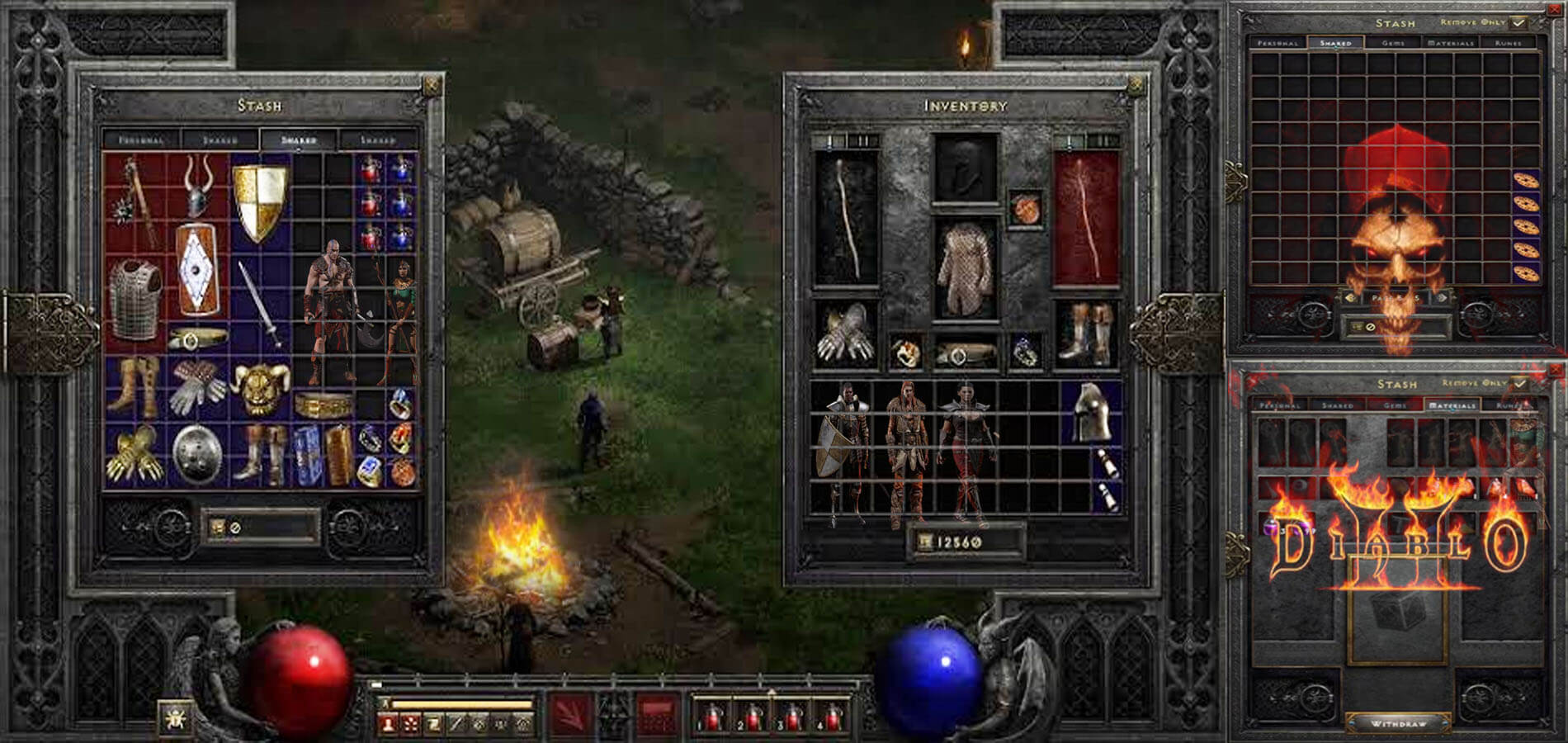 Diablo II Resurrected offers a robust competitive environment through its distinct Ladder modes. Players can choose to compete in the classic 4-Act Pre-Expansion Ladder, the unforgiving Pre-Expansion Hardcore Ladder with its single-life permadeath rule, the standard 5-Act Ladder that includes the Lord of Destruction expansion, or the Hardcore Ladder (Lord of Destruction) for the ultimate challenge. This variety caters to a broad spectrum of player preferences, from those seeking a nostalgic return to the original experience to those craving the heightened stakes of hardcore gameplay. The transition from a Ladder season to non-ladder is a crucial aspect of the game's ongoing lifecycle. When a season concludes, characters are moved to non-ladder, and their shared stash items are placed in "Withdraw Only" tabs. It is imperative for players to be mindful of these "Withdraw Only" tabs, as they are overwritten at the end of the subsequent season. This system encourages players to carefully manage their inventory and prioritize the retrieval of essential gear from previous Ladder runs before they are permanently lost.
Patch 3.3: Impact on Gameplay and Builds
 The impact of Patch 3.3 on Diablo II Resurrected is profound, particularly concerning item changes and build tweaks. The deliberate redistribution of former Ladder-exclusive runewords, such as Mania, Hysteria, Metamorphosis, Ground, Temper, Hearth, Cure, and Bulwark, into non-ladder play is a significant development. This move democratizes access to powerful crafting recipes, fostering a more diverse and experimental meta across all game modes. Furthermore, updates to levelling uniques and runewords are designed to make initial playthroughs more rewarding and engaging. By providing more impactful gear options earlier in the game, Blizzard aims to reduce the feeling of stagnation that some players experience during the early levelling stages. This ensures that players can more readily experiment with different builds and find powerful synergies as they progress, making each new character creation feel fresh and exciting.
Itemization Tweaks for Early Game Viability
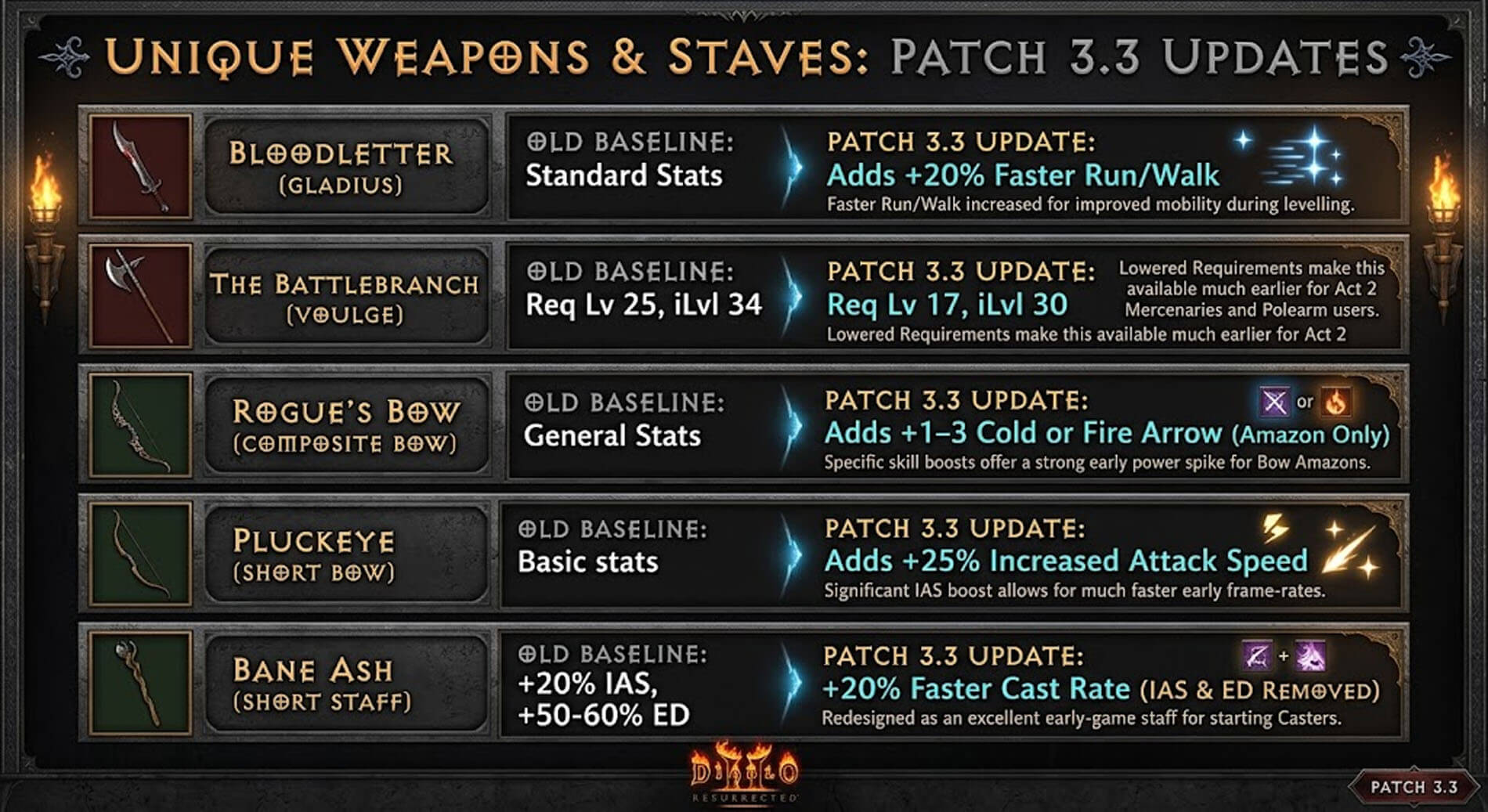
A significant focus of the Season 15 update lies in empowering classic levelling items, making the journey through the earlier acts more engaging and efficient. Items like Bloodletter have seen their base movement speed increased, providing Barbarians and other melee builds with crucial early mobility. This seemingly small buff can translate into a smoother and more enjoyable levelling experience, reducing the tedium of slow traversal. Similarly, the Battlebranch polearm has had its level requirement reduced, accelerating the effectiveness of Act 2 mercenary companions and players opting for polearm builds in the early game. Rogue's Bow and Pluckeye have also been addressed, both offering substantial buffs for missile characters. Rogue's Bow now provides a more potent early boost to Cold Arrow or Fire Arrow for Amazons, creating a significant power spike. Pluckeye’s increased attack speed further enhances the frame rates for characters relying on ranged attacks, a tangible improvement for fluidity. Bane Ash, a former caster staff, has been redesigned to better serve its intended purpose as an early-game caster item, removing its previous IAS and ED bonuses and focusing on its caster utility. Gravenspine’s Faster Cast Rate has been buffed, directly complementing Necromancer breakpoint targets for casters looking to optimize their spellcasting speed from the outset. Even the Blinkbat's Form chest armor receives a notable upgrade with increased Faster Run/Walk and Mana After Each Kill, making it an exceptional choice for speed-running and mana sustain during levelling. The Ward armor’s addition of an open socket is a simple yet impactful change, allowing for early customization with runes or gems, adding another layer of strategic choice. Manald Heal’s increased Faster Cast Rate broadens its appeal for casters requiring early FCR and mana regeneration.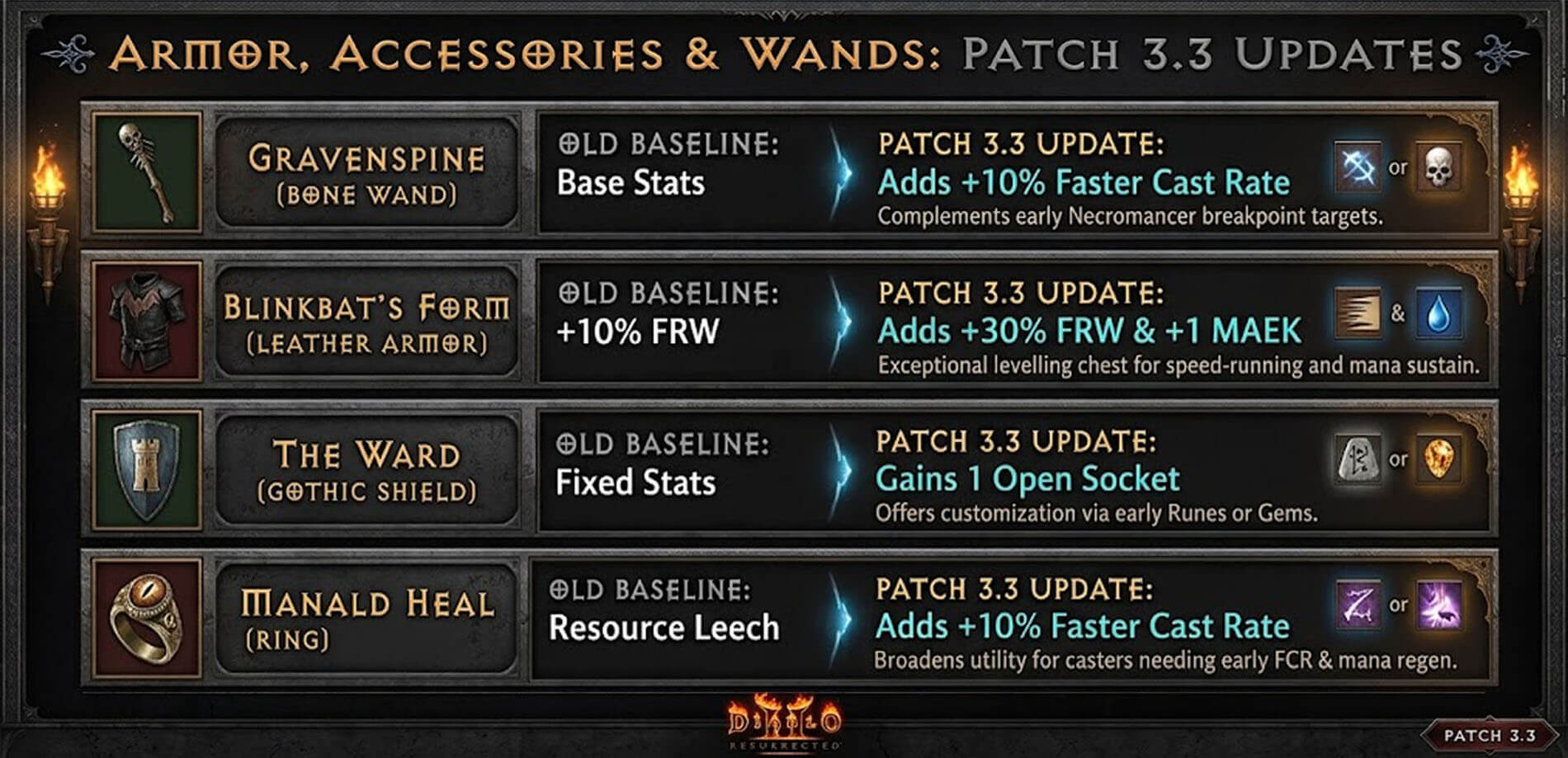
The Angelic Raiment Set Rebalance and Endgame Adjustments
Beyond individual item buffs, the Angelic Raiment set has undergone a significant rebalance. The Sickle now grants flat damage with three set pieces, while the Mantle offers increased damage against undead. The most impactful change, however, is the full set bonus now awarding +1 to All Skills. This elevates the set’s utility, making it a more compelling option for a wider range of characters, particularly during the mid-to-late levelling stages or even as an accessible endgame option for certain builds. The endgame loop has also been reshaped through adjustments to Herald Tiers and the probability of obtaining high-value drops. Herald Tier 3 and above now have a higher chance of dropping rare or better-quality gear, incentivizing players to push through higher difficulty tiers. A critical change affects Latent Sunder Charms: their minimum drop level has been increased to 75, and their Magic Find drop rates have been reduced. Furthermore, these powerful charms will now exclusively drop from Magic Find sources in Hell difficulty. This deliberate recalibration aims to make Sunder Charms a more significant endgame achievement, requiring dedicated farming and increasing their perceived value. The overall drop rates for Worldstone Shards and Ancient Statues have also been reduced, further emphasizing the rarity and importance of these endgame progression elements.Enhancing Stability and Gameplay Integrity
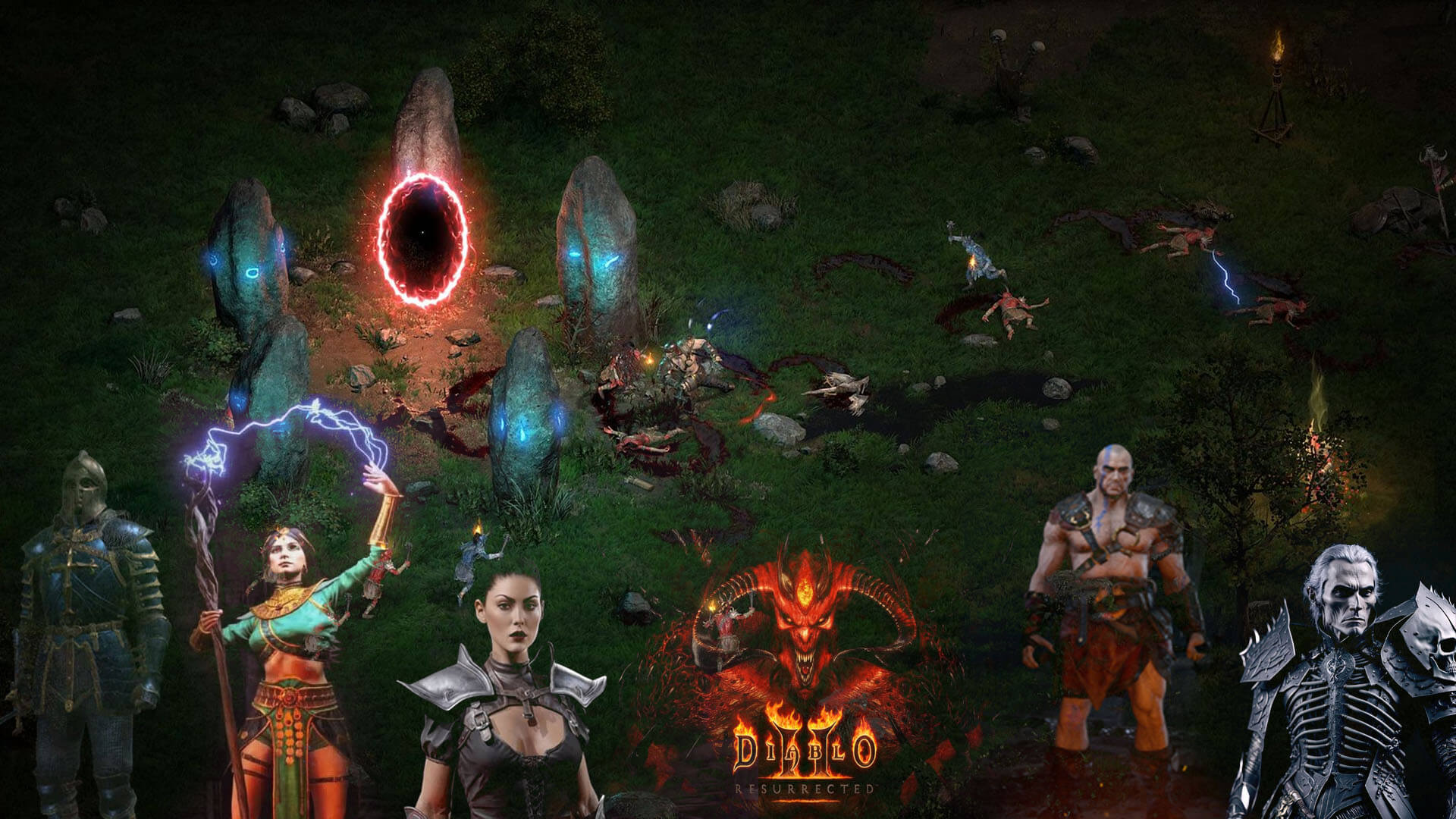 The release of Patch 3.3 for Ladder Season 15 signifies a crucial step in maintaining the high standards of Diablo II: Resurrected. The patch meticulously targets and rectifies several key mechanical bugs that could have detracted from the gameplay experience. Among the most significant are the fixes related to skill mechanics. For instance, the issue where Bind Demon’s extra damage scaling was not functioning correctly has been resolved. This ensures that players investing in this skill can rely on its intended power progression. Furthermore, the problematic behavior of Sigil: Death, which previously consumed mana even on failed casts or miscalculated Fire Skill bonuses, has been corrected. Such precision in skill functionality is vital for players who meticulously build their characters around specific synergies and damage types.
Beyond skill-specific adjustments, the patch also addresses critical issues concerning collision and pathing. The Miasma Chain, for example, will no longer register unwanted missile collisions with friendly or neutral units. This prevents frustrating moments where a player’s own abilities inadvertently disrupt their progress or allies. Similarly, the long-standing bug that caused players to become stuck in the Leap landing animation has been fixed. This not only improves the fluidity of movement for classes that utilize such abilities but also eliminates a common source of player annoyance and potential death in critical encounters.
The AI and loot systems, cornerstones of Diablo II’s addictive loop, also received attention. Boss AI freezes, a disruptive bug that could halt combat progression, have been resolved. This ensures that boss encounters remain challenging and dynamic as intended. A specific fix for Council Members failing to drop items as Heralds further refines the loot generation system, ensuring that valuable opportunities for obtaining rare gear are not missed due to technical oversight. Finally, user interface and controller usability have been enhanced. The bulk key purchase issue from Hratli on controllers, a minor but persistent inconvenience, has been corrected. Additionally, visual errors in the Chronicle UI have been cleared, contributing to a cleaner and more intuitive interface. Collectively, these fixes demonstrate a commitment to polishing the player experience, ensuring that the core gameplay mechanics are as robust and enjoyable as possible.
The release of Patch 3.3 for Ladder Season 15 signifies a crucial step in maintaining the high standards of Diablo II: Resurrected. The patch meticulously targets and rectifies several key mechanical bugs that could have detracted from the gameplay experience. Among the most significant are the fixes related to skill mechanics. For instance, the issue where Bind Demon’s extra damage scaling was not functioning correctly has been resolved. This ensures that players investing in this skill can rely on its intended power progression. Furthermore, the problematic behavior of Sigil: Death, which previously consumed mana even on failed casts or miscalculated Fire Skill bonuses, has been corrected. Such precision in skill functionality is vital for players who meticulously build their characters around specific synergies and damage types.
Beyond skill-specific adjustments, the patch also addresses critical issues concerning collision and pathing. The Miasma Chain, for example, will no longer register unwanted missile collisions with friendly or neutral units. This prevents frustrating moments where a player’s own abilities inadvertently disrupt their progress or allies. Similarly, the long-standing bug that caused players to become stuck in the Leap landing animation has been fixed. This not only improves the fluidity of movement for classes that utilize such abilities but also eliminates a common source of player annoyance and potential death in critical encounters.
The AI and loot systems, cornerstones of Diablo II’s addictive loop, also received attention. Boss AI freezes, a disruptive bug that could halt combat progression, have been resolved. This ensures that boss encounters remain challenging and dynamic as intended. A specific fix for Council Members failing to drop items as Heralds further refines the loot generation system, ensuring that valuable opportunities for obtaining rare gear are not missed due to technical oversight. Finally, user interface and controller usability have been enhanced. The bulk key purchase issue from Hratli on controllers, a minor but persistent inconvenience, has been corrected. Additionally, visual errors in the Chronicle UI have been cleared, contributing to a cleaner and more intuitive interface. Collectively, these fixes demonstrate a commitment to polishing the player experience, ensuring that the core gameplay mechanics are as robust and enjoyable as possible.
The Unwavering Appeal of Diablo II
The continued thriving of Diablo II, even with the release of Resurrected and subsequent patches, can be attributed to its deeply satisfying foundational mechanics. The combat pacing is undeniably crisp, offering a fluid and responsive experience that makes every swing, spell, and dodge feel impactful. This immediacy is crucial in an action-RPG, where players are constantly engaged in fast-paced encounters. Furthermore, the meaningful character attribute choices provide a depth that encourages re-playability and strategic planning. Allocating points into strength, dexterity, vitality, and energy allows players to tailor their characters to distinct playstyles, whether they favor brute force, nimble evasion, or powerful spellcasting. This sense of agency in character building is a significant draw. However, the most potent allure of Diablo II lies in its high-stakes loot hunting. The thrill of defeating formidable enemies and uncovering powerful items, from common upgrades to legendary artifacts, is an addictive cycle. The randomized nature of item drops, coupled with the vast array of possible affixes and unique properties, creates a perpetual sense of anticipation and discovery. Each monster slain, each boss vanquished, presents an opportunity for a game-changing piece of gear. This pursuit of the perfect item drives players through countless hours of gameplay, fostering a dedicated community that actively shares strategies and celebrates rare finds. Ladder Season 15, with its clean slate and fresh economy, provides the ideal environment for both veteran players looking to optimize new builds and newcomers eager to experience the quintessential Diablo II loot hunt for the first time. The patch’s stability improvements ensure that this pursuit is not marred by technical frustrations, allowing the core gameplay loop to shine.Read more →
Diablo Expands Beyond the Game with Netflix, Amazon, Diablo V
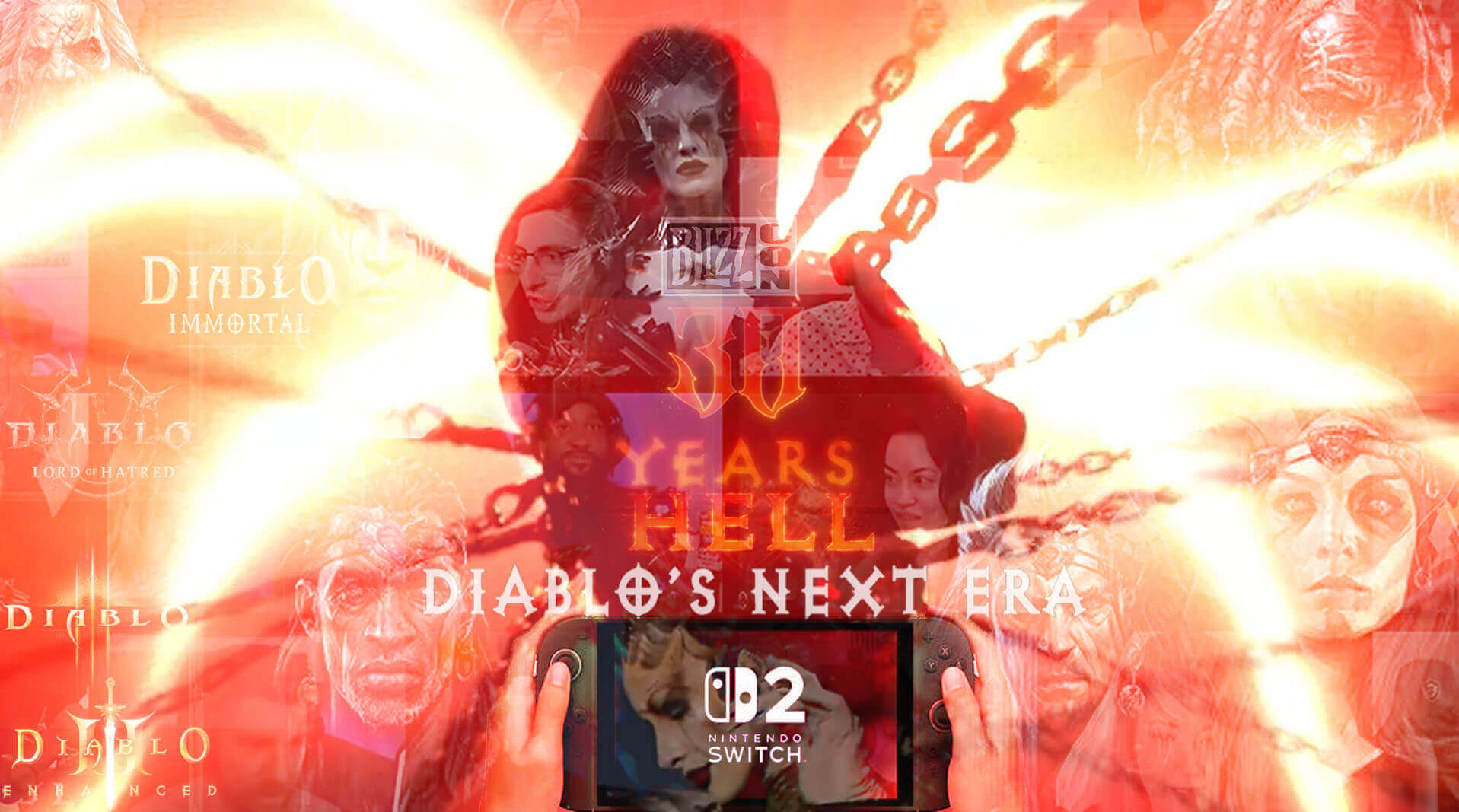
Two Major Ways Diablo Is Expanding
Blizzard Entertainment's strategic expansion of the Diablo franchise, as exemplified by the upcoming Netflix animated series and the Amazon expansion for Diablo IV, signifies a monumental shift towards a more expansive and multi-faceted universe. These two initiatives, while distinct in their approach, are united in their ambition to broaden Diablo’s appeal and deepen its lore. The Netflix series ventures into the realm of passive visual storytelling, aiming to introduce the grim tapestry of Sanctuary to a global television audience. This endeavour holds the potential to translate the franchise’s core themes of eternal conflict, demonic corruption, and heroic struggle into a narrative format accessible to newcomers and enriching for long-time fans. By exploring the psychological depths of characters and the visually terrifying landscapes of Sanctuary, the series can offer a new dimension to the established mythology. Simultaneously, the Amazon expansion for Diablo IV reinforces the franchise’s interactive heart. This substantial addition to the game promises new playable content, narrative arcs, and exploration opportunities, ensuring the longevity and continued engagement of its player base. It represents a commitment to evolving the core gaming experience, delving further into the rich lore of Sanctuary and offering fresh challenges that align with the franchise’s action role-playing roots. The synergy between these two expansions is a key element of this strategy. The animated series can serve as a powerful gateway, introducing the Diablo universe to a wider audience, while the game expansion provides a continually evolving interactive world for dedicated fans. This dual approach creates a feedback loop, where each facet of the franchise can inform and enhance the other, fostering a more cohesive and immersive experience across different forms of entertainment. As the Netflix series moves through its development and the Amazon expansion prepares for its 2027 release, the future of Diablo appears poised for significant growth, promising a continued unfolding of Sanctuary’s dark and captivating story across an ever-widening canvas. The universe of Diablo is vast, and these expansions are clear indicators that its exploration is only just beginning, ensuring its legacy as a cornerstone of dark fantasy entertainment for years to come.Diablo Is Coming to Netflix
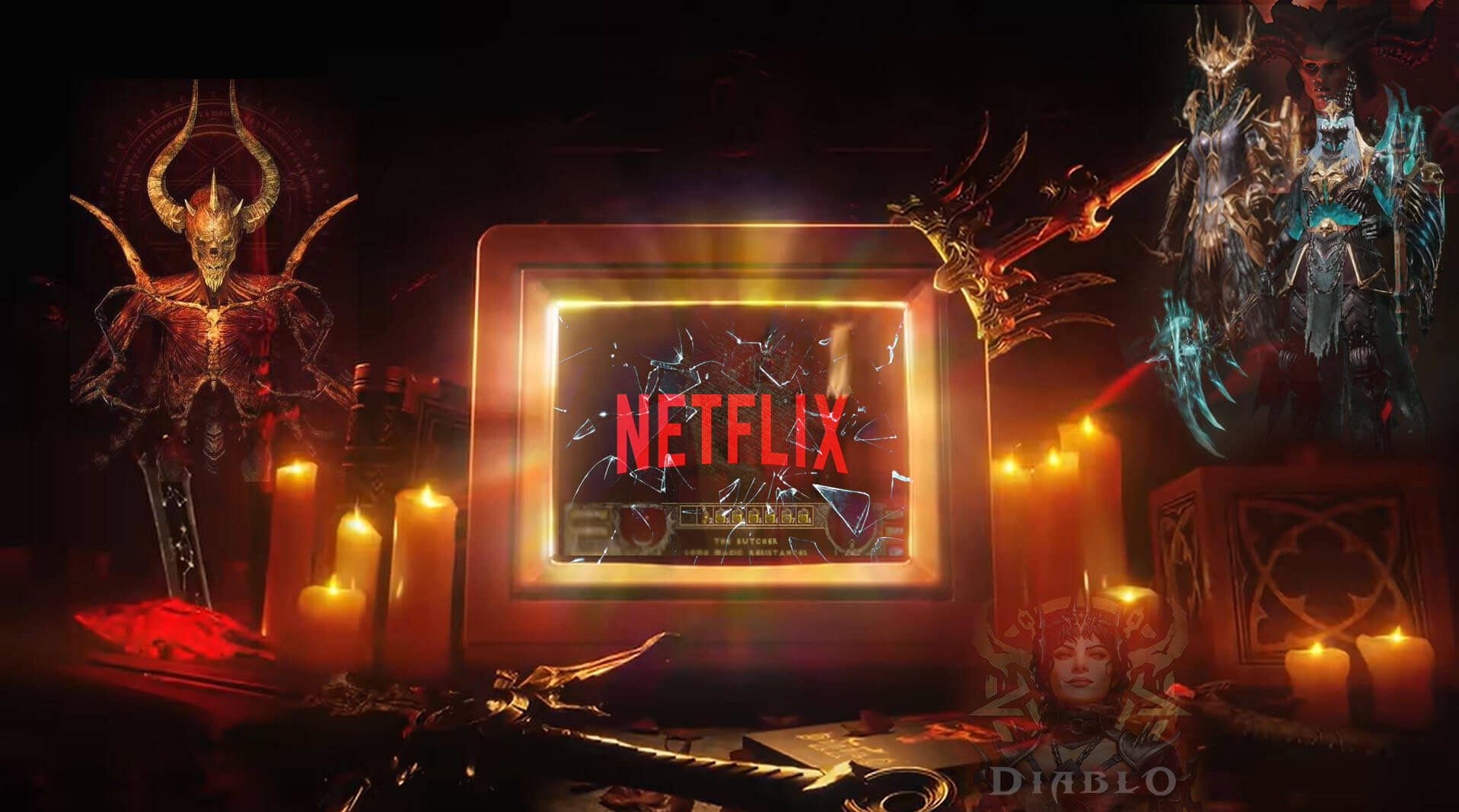 Blizzard Entertainment, in collaboration with Netflix, has officially embarked on the development of a new animated series that promises to immerse audiences in the grim realities of Sanctuary. This significant announcement, revealed during the BlizzCon 2026 Opening Ceremony, marks a pivotal moment for the legendary action RPG series, heralding its expansion into the realm of animated television. The prospect of a Diablo animated series on a global platform like Netflix opens a vast landscape of narrative possibilities, offering both long standing fans and newcomers an opportunity to explore the rich mythology and pervasive darkness that defines this beloved universe.
The World of Sanctuary on Screen
Sanctuary, the central setting of the Diablo franchise, is a world perpetually caught in the crossfire of the eternal war between the High Heavens and the Burning Hells. This inherently dramatic backdrop provides a fertile ground for storytelling, rich with ancient conflicts, fallen heroes, and the desperate struggles of mortals caught in a cosmic struggle. The games have always excelled at establishing a palpable atmosphere of dread and despair, punctuated by visceral combat and tales of corruption, sacrifice, and the indomitable will to survive. An animated series has the potential to translate this unique ambiance to a visual medium, allowing for intricate world building and character development that might be constrained by the interactive nature of video games. Viewers can anticipate exploring the lore in new ways, perhaps delving into the backstories of key figures, witnessing pivotal historical events that shaped Sanctuary, or even experiencing an entirely fresh narrative woven into the established tapestry of demons, angels, and humanity’s fragile existence. The success of Netflix’s ventures into adapting video game properties, such as Arcane based on League of Legends, has demonstrated the viability and potential of high-quality animated series within this space. These adaptations have often been praised for their fidelity to the source material’s spirit while also carving out their own unique artistic identities. For Diablo, this presents an opportunity to visually interpret the grotesque beauty of its demonic designs, the stoic resilience of its human characters, and the epic scale of its battles. The dark, gothic aesthetic that has long been a hallmark of the Diablo games can be brought to life with stunning animation, making the supernatural threats feel more tangible and the stakes of Sanctuary’s survival more immediate. Furthermore, the series could delve into the moral ambiguities that often characterize the franchise, exploring the difficult choices characters are forced to make and the corrupting influence of the eternal conflict on even the noblest souls.Narrative Potential and Fan Anticipation
While specific details regarding plot, characters, and release dates remain under wraps as production progresses, the mere announcement has ignited considerable anticipation within the Diablo fanbase. Longtime players are eager to see how familiar elements of the franchise will be translated to the screen. This could include revisiting iconic locations like Tristram, seeing beloved heroes and villains brought to life, or even exploring narrative threads that have only been hinted at in the games. The open-ended nature of the Diablo lore means that the animated series could serve as a prequel, a sequel, or an independent story that expands the universe without retreading familiar ground. The phrase "Stay awhile... and stay tuned" from the announcement serves as a tantalizing promise of more information to come, hinting at a project that is being carefully crafted to satisfy both the existing community and a broader audience. The potential for exploring the motivations of demons, the complexities of angelic hierarchies, and the enduring spirit of humanity in the face of overwhelming darkness is immense. This new medium offers a unique opportunity to build upon the established lore, adding depth and new dimensions to the ongoing saga of Diablo. ↑ Back to TopThe Amazon Enters the Battle in Diablo IV
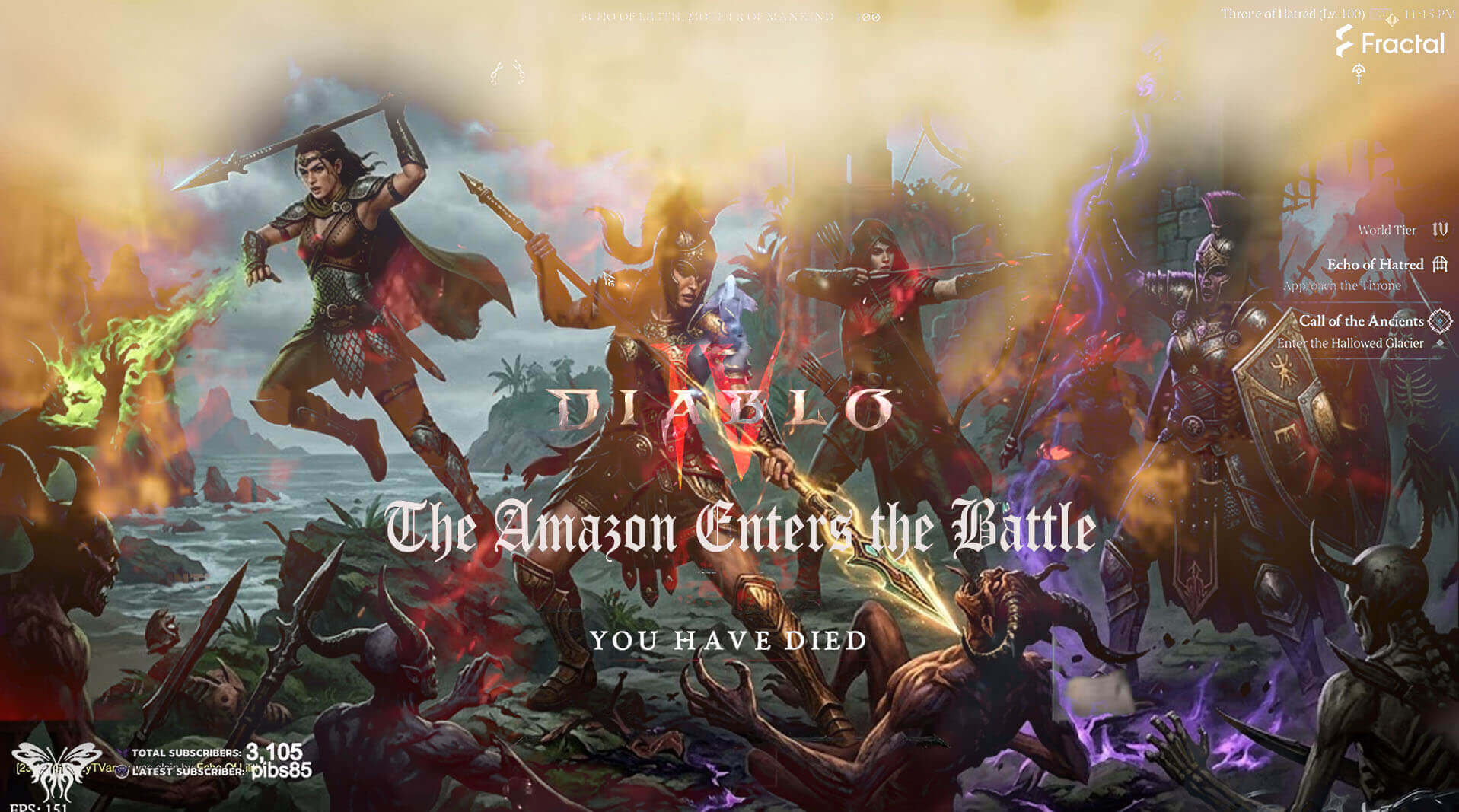 The integration of the Amazon into Diablo IV is not merely a cosmetic update or a simple port of a beloved character; rather, it signifies a thoughtful reimagining, a strategic expansion of the game's lore and mechanics, and a testament to Blizzard Entertainment's commitment to evolving its flagship action RPG. The journey toward her reintroduction begins with a geographical anchor, leading players to Skovos, the storied island region intrinsically linked to the Amazon's origins and first prominently featured in the Lord of Hatred expansion. This deliberate placement offers a natural and immersive connection, weaving the character's rich history into the ever-expanding tapestry of Sanctuary. By transcending a straightforward replication of her Diablo II iteration, the developers aim to craft an Amazon that feels both familiar and fresh, a warrior whose identity is forged through a deeper exploration of her martial discipline, athletic capabilities, and the esoteric Askari heritage that defines her unique approach to combat. This reimagining is poised to deliver a class built around a foundation of mobility and versatility, empowering players to engage with Sanctuary's threats through a fluid and dynamic combat system, capable of seamlessly transitioning between diverse engagement ranges and tactical approaches.
A Reimagined Warrior for a New Era
The decision to reimagine the Amazon for Diablo IV, rather than simply porting her classic iteration, reflects a broader design philosophy aimed at ensuring class identity and gameplay distinctiveness within the modern Diablo landscape. In Diablo II, the Amazon was primarily defined by her mastery of ranged weaponry, particularly bows and crossbows, complemented by her proficiency with throwing spears. While these core elements remain, the Diablo IV iteration seeks to imbue her with a more holistic warrior identity, one that extends beyond mere weapon specialization. This evolution is rooted in her "Askari heritage," a term that hints at a deeper wellspring of power and tradition. The Askari, presumably a culture or lineage deeply connected to the Amazon's origins, serve as the fount of her mystical abilities. This infusion of mysticism moves the Amazon beyond a purely physical combatant, allowing for a more intricate and layered gameplay experience. Her combat style is described as a synthesis of athletic movement, martial expertise, and these newfound mystical powers. This tripartite approach suggests that players will not only be executing skilful dodges and precise strikes but also channelling esoteric energies to augment their attacks, disrupt enemies, or enhance their survivability. The emphasis on "athletic movement" is particularly noteworthy. In the fast-paced and often chaotic battles of Diablo IV, a character's ability to reposition, evade, and control space is paramount. An Amazon designed with inherent mobility will be able to dart in and out of danger, maintain optimal engagement distances, and exploit enemy openings with a grace and speed that distinguishes her from other classes. This focus on dynamic movement ensures that the Amazon is not a static turret but an active participant in the ebb and flow of battle, constantly dictating the terms of engagement. Furthermore, the idea of transitioning "fluidly between different forms of combat" implies a versatility that caters to a wide range of player preferences and tactical situations. Whether facing a horde of lesser demons at range, engaging a hulking boss in the mid-range, or needing to quickly close the distance to deliver a decisive blow, the reimagined Amazon is envisioned as a master of adaptation, capable of shifting her approach on the fly. This multifaceted design promises a character that is not only powerful but also deeply engaging, rewarding strategic play and a nuanced understanding of combat mechanics.
A Multifaceted Warrior
Central to this ongoing struggle are the playable classes, each offering a distinct approach to combating the demonic hordes. Among these, the return of the Amazon class marks a significant development, promising a blend of familiar prowess and innovative gameplay. Blizzard has outlined four broad archetypes that help define the Amazon's gameplay: Champion, Skirmisher, Ranger, and Commander. These archetypes are not rigid definitions but rather guiding principles that allow for a wide spectrum of player expression, ensuring that the Amazon is far more than a one-dimensional warrior.The Ranger: Precision and Distance
The Ranger archetype embodies the classic archer or spear-wielder, a master of ranged combat who prioritizes keeping enemies at a safe distance while systematically dismantling them. This playstyle is deeply rooted in the history of the Amazon class in previous Diablo titles, where accurate volleys of arrows and javelins were a hallmark of her effectiveness. In Diablo IV, the Ranger archetype will likely focus on high single-target damage, critical hits, and crowd control abilities that hinder enemy advances. Think of skills that might imbue projectiles with elemental effects, allowing players to freeze, burn, or even stun foes before they can close the gap. This archetype thrives on positioning, requiring players to constantly assess their surroundings, find advantageous vantage points, and kite enemies effectively. Success as a Ranger relies on a keen understanding of enemy attack patterns and the ability to predict their movements, enabling precise shots that exploit weaknesses. The Ranger’s toolkit will likely feature a variety of powerful ranged attacks. These could include rapid-fire abilities for sustained damage, slower but more impactful shots for breaking through defenses, and perhaps even area-of-effect projectiles that can damage groups of enemies caught in the blast radius. Mobility skills will also be crucial, allowing the Ranger to quickly reposition herself, creating more space or escaping imminent danger. Imagine a skill that grants a temporary speed boost or a short-range teleport, enabling her to maintain her optimal engagement distance. Furthermore, the Ranger might have access to traps or snares, providing additional means to control the battlefield and funnel enemies into kill zones. These utility skills would complement her offensive capabilities, making her a strategic asset in both solo play and group content. The inherent vulnerability of a ranged character in a game known for its relentless onslaught of enemies means that mastering the Ranger archetype requires a high degree of player skill and tactical awareness. Every missed shot, every misstep in positioning, can lead to swift and brutal consequences. However, for those who master her arts, the Ranger offers the satisfaction of a calculated and efficient kill, a testament to skill and precision against overwhelming odds.
The Skirmisher: Mobility and Aggression
In stark contrast to the calculated distance of the Ranger, the Skirmisher archetype embodies a more aggressive and mobile approach to combat. This playstyle is designed around dynamic movement, weaving in and out of combat to strike enemies and then repositioning before opponents can effectively retaliate. The Skirmisher is not about enduring blows but about avoiding them through sheer agility and well-timed assaults. Her combat identity is built around rapid strikes, quick dodges, and the ability to capitalize on brief openings. This archetype encourages players to be proactive, to dictate the flow of combat through their constant movement and opportunistic attacks. The Skirmisher's gameplay loop revolves around engaging enemies, dealing swift damage, and then disengaging or repositioning to avoid incoming attacks. This might involve a series of rapid melee strikes, followed by a quick dash away, or perhaps a flurry of thrown weapons followed by a roll to safety. The emphasis is on overwhelming opponents with a relentless but fleeting presence. Skills associated with the Skirmisher archetype would likely focus on enhancing her speed, her evasive capabilities, and the damage output of her close-quarters or short-range attacks. Think of abilities that grant temporary bonuses to attack speed after a dodge, or skills that allow her to chain multiple attacks together with increased mobility between them. She might also have access to abilities that disorient enemies or create brief windows of vulnerability, allowing her to exploit them before they can react. The Skirmisher’s success hinges on her ability to maintain momentum and to never remain stationary for too long. This playstyle demands quick reflexes and a deep understanding of enemy attack patterns, not to avoid them from afar, but to time her movements precisely between them. It is a dance of death, a constant ebb and flow where the Skirmisher is always on the move, a blur of motion delivering devastating blows. The risks are higher for a Skirmisher, as she is more likely to be caught in the fray. However, the rewards can be equally significant, with the potential for explosive bursts of damage and the exhilarating feeling of outmanoeuvring and outplaying formidable foes. This archetype offers a high-octane playstyle that rewards aggressive risk-taking and masterful control of character movement.The Champion: Resilience and Defence
The Champion archetype introduces a facet of the Amazon that leans towards resilience, defence, and perhaps even a more front-line combat role. While the classic Amazon was often perceived as a glass cannon, the Champion suggests a build that can withstand more punishment and engage enemies more directly, without necessarily sacrificing her offensive potential entirely. This archetype focuses on survivability, enabling the Amazon to hold her ground and protect allies, or to simply endure longer in challenging encounters. Skills associated with the Champion would likely enhance her defensive capabilities. This could involve temporary increases to her armour, the addition of magical shields, or abilities that absorb incoming damage and convert it into offensive power. The Champion might also have access to skills that taunt enemies, drawing their aggression and protecting squishier allies. Furthermore, this archetype could incorporate abilities that regenerate health or provide temporary immunities to certain status effects, further bolstering her survivability. The playstyle of a Champion might involve wading into the thick of combat, using her enhanced defences to absorb blows while still delivering consistent damage. She wouldn't be a pure tank in the vein of a Barbarian, but rather a more robust and self-sufficient combatant. The Champion archetype allows for a more forgiving playstyle, making the Amazon accessible to players who prefer a slightly less demanding approach to positioning and evasion. It opens up opportunities for the Amazon to act as a vanguard, drawing enemy attention and creating openings for other party members. While the Ranger and Skirmisher focus on exploiting enemy weaknesses through distance or evasion, the Champion excels at weathering the storm and turning enemy aggression into an advantage. This archetype demonstrates that the Amazon is not solely defined by her ranged attacks or nimble footwork but can also embody a formidable presence on the battlefield, a steadfast warrior capable of enduring and overcoming the most harrowing challenges through sheer fortitude and strategic defence.The Commander: Leadership and Support
The Commander archetype broadens the Amazon's role beyond direct combat, suggesting a capacity for leadership and support within a party. This playstyle focuses on enhancing the effectiveness of allies and controlling the flow of battle through strategic buffs, debuffs, and perhaps even summoning capabilities. The Commander embodies the idea of a seasoned warrior who inspires her comrades and orchestrates their efforts for maximum impact. This archetype offers a unique dimension to the Amazon, moving her away from being purely a damage dealer and into a more utility-focused role. The Commander’s toolkit would likely include abilities that bolster her allies' offensive or defensive capabilities, such as temporary increases to damage, attack speed, or armor. She might also possess skills that debuff enemies, reducing their damage output or weakening their resistances, making them easier targets for her party. Furthermore, the Commander archetype could introduce the ability to summon allies or spirits to fight alongside her, providing additional forces on the battlefield. Imagine skills that conjure spectral warriors, or formations that grant passive bonuses to nearby allies. The Commander's role is to amplify the strengths of her party and mitigate their weaknesses, acting as a force multiplier on the battlefield. Playing as a Commander would require a different kind of strategic thinking. Instead of focusing solely on her own actions, the player would need to be keenly aware of her party's composition and their current needs. She would be a crucial element in coordinating group efforts, identifying optimal moments to deploy buffs or debuffs, and ensuring that her summoned allies are effectively utilized. This archetype allows the Amazon to contribute significantly to a party's success through tactical acumen and supportive abilities, demonstrating that strength can also be found in guidance and enablement. The Commander archetype ensures that the Amazon class can be a vital component of any adventuring party, offering a strategic depth that extends beyond individual combat prowess.
The Javelin: A New Edge in Combat
Among the most significant mechanical innovations accompanying the Amazon's arrival is the introduction of the Javelin as a distinct weapon type within Diablo IV. This is not merely an aesthetic addition; it represents a fundamental expansion of the game's combat system and offers a compelling new avenue for the Amazon's offensive capabilities. The javelin serves a dual purpose: it allows the Amazon to maintain her efficacy at range, providing a viable alternative to bows for players who prefer a slightly closer engagement or a different projectile trajectory, while simultaneously supporting a more aggressive mid-range and even close-combat playstyle. This duality is crucial in differentiating the Amazon from existing ranged-focused classes, such as the Ranger or Hunter archetypes that might exist in other games or could be introduced in Diablo IV. While other ranged characters might excel at holding a static position and unleashing sustained volleys, the javelin imbues the Amazon with a dynamic offensive presence. Throwing javelins can be a rapid, impactful action, allowing for quick bursts of damage as the Amazon weaves through combat. The potential for skills that enhance javelin throws, such as increased velocity, piercing capabilities, or explosive impacts, opens up a wealth of build diversity. Moreover, the javelin’s effectiveness at mid-range creates a unique tactical niche. Players can engage enemies from a distance that is too close for a typical bow shot to be optimally effective, but still far enough to avoid the immediate dangers of melee. This allows for a "dance" of combat, where the Amazon can kite enemies, reposition, and strike with javelins, drawing enemies into unfavourable positions or punishing their attempts to close the gap. The impact of a well-thrown javelin can be substantial, and skills could leverage this by offering crowd control effects, such as staggering or knocking back enemies, further enhancing the Amazon's ability to dictate the flow of battle. Crucially, the developers have confirmed that the Amazon will continue to utilize bows, preserving one of the most recognizable and beloved elements of her classic identity. This ensures that players who cherish the long-range precision and devastating power of the bow will find a familiar and satisfying playstyle available. The synergy between bows and javelins is where the true potential of the Amazon's versatility shines. Players can envision builds that seamlessly transition between long-range engagements with bows, drawing enemy attention and thinning their ranks from afar, and more immediate threats where rapid-fire javelins become the primary offensive tool. For instance, a player might open combat with a series of precise bow shots to eliminate priority targets, then switch to javelins as enemies close in, using their mobility to evade and strike, creating an aggressive and engaging rhythm. Conversely, a player might prefer a javelin-centric build, using their mobility to dart around the battlefield, hurling javelins with relentless accuracy, and only resorting to bows for specific tactical advantages or to conserve javelin-related resources if such mechanics are implemented. This inherent flexibility in weapon choice, coupled with the distinct advantages each weapon type offers, grants players considerable freedom in how they approach character building and combat strategy. The Amazon becomes a canvas for diverse playstyles, from the patient archer to the aggressive spear wielder, and even to hybrid approaches that leverage the strengths of both. This strategic depth ensures that the Amazon will not only be a powerful addition to Sanctuary but also a deeply rewarding character to master. The introduction of the javelin as a distinct weapon type is therefore a masterstroke, providing a fresh mechanic that amplifies the Amazon's established strengths while opening up entirely new possibilities for engaging with the ever-present demonic threat.The Skovos Archipelago: A Lore-Rich Setting
The choice to introduce the Amazon's return alongside the exploration of the Skovos Archipelago is a strategic masterstroke, deeply entwined with the lore and established history of the Diablo universe. Skovos, a region first explored in the Lord of Hatred expansion for Diablo II, is intrinsically linked to the Amazon's origins, serving as the homeland of her people and the crucible in which their warrior traditions were forged. This geographical anchor provides a natural and immersive narrative foundation for the Amazon's re-emergence in Diablo IV. Rather than introducing a new character in a vacuum, her arrival is contextualized within a familiar yet expanded locale, allowing players to connect her personal journey with the broader narrative of Sanctuary. The Skovos Archipelago, with its lush environments, ancient traditions, and potential for unique threats and allies, offers a fertile ground for storytelling. Its exploration can delve into the cultural nuances of the Amazon people, their relationship with the natural world, and the spiritual or mystical underpinnings of their martial prowess. The presence of the Askari heritage, as mentioned earlier, can be further elaborated upon within the context of Skovos, perhaps revealing specific rituals, philosophies, or even ancient deities that inform the Amazon's abilities. This approach not only enriches the player's understanding of the Amazon as a character but also expands the playable world of Diablo IV, offering new environments to discover and conquer. The lore surrounding Skovos can provide unique questlines, introduce new enemy types endemic to the region, and offer opportunities for players to interact with NPCs who shed light on the Amazon's past and present. The island setting itself can contribute to gameplay, perhaps with terrain features that favor certain combat styles or introduce environmental hazards that players must navigate. For example, dense jungles could offer opportunities for stealth and ambushes, while rugged coastlines might present challenges for movement and positioning. The connection to Lord of Hatred also allows for the potential reintroduction or reimagining of characters or factions from that expansion, creating a sense of continuity for long-time fans while providing fresh content for newer players. The thematic resonance of returning to a region tied to a classic character's origin story adds a layer of nostalgic appeal, while the promise of new content ensures that the experience remains engaging and forward-looking. By situating the Amazon's re-entry within the Skovos Archipelago, Blizzard is not just adding a new class; they are weaving a richer narrative tapestry for Diablo IV, deepening its lore, and expanding its world in a way that feels organic and meaningful. This careful integration of character and setting ensures that the Amazon's arrival is more than just a gameplay addition; it is an event that contributes to the ongoing saga of Sanctuary.Mobility and Versatility: The Core Gameplay Pillars
The fundamental design principles guiding the reimagined Amazon in Diablo IV revolve around two core pillars: mobility and versatility. These principles are not merely buzzwords; they translate into tangible gameplay mechanics that aim to create a distinct and engaging player experience. The emphasis on "athletic movement" suggests that the Amazon will possess inherent abilities that allow her to traverse the battlefield with exceptional agility. This could manifest in the form of enhanced dodge rolls, a short-range dash, or even abilities that allow her to quickly scale terrain or bypass obstacles. In the chaotic onslaught of Diablo IV's combat, where overwhelming numbers of enemies are a constant threat, the ability to efficiently reposition oneself is crucial for survival and for optimizing offensive opportunities. An Amazon that can fluidly evade incoming attacks, quickly close the gap to engage a priority target, or disengage from a dangerous situation without sacrificing momentum will feel inherently dynamic and empowering to play. This enhanced mobility also serves to differentiate her from other classes. While some classes might rely on defensive cooldowns or static positioning, the Amazon's mobility is likely to be a more active and ever-present aspect of her toolkit. The concept of "versatility" is intrinsically linked to her mobility and her dual weapon mastery. It implies that the Amazon is not confined to a single combat role or engagement range. As discussed with the introduction of the javelin, she can effectively engage enemies at long, mid, and potentially even close ranges. This adaptability allows players to tailor their playstyle to their preferences and to the specific challenges presented by different enemy encounters. A player might choose to focus on long-range archery for crowd control and boss damage, or they might favor a more aggressive, javelin-focused build that emphasizes close-quarters skirmishing and rapid evasion. The synergy between her physical prowess and her mystical abilities further enhances this versatility. Imagine skills that allow her to imbue her javelins with elemental effects, creating area-of-effect damage or debilitating status conditions. Or perhaps her athletic movement can be augmented by mystical enhancements, allowing her to move faster, jump further, or even phase through enemies for a brief period. This integration of physical and mystical elements creates a character that is not only capable but also multifaceted, offering a rich array of build options and strategic approaches. The ability to transition "between different forms of combat" means that the Amazon can adapt to changing battlefield conditions. If an encounter starts with a large group of ranged enemies, she can utilize her bows to pick them off from a safe distance. If those enemies are then reinforced by melee attackers, she can seamlessly switch to javelins and utilize her mobility to kite and control the melee swarm, or even engage them directly with a more aggressive, agile style. This adaptability ensures that the Amazon remains a relevant and powerful force regardless of the enemy composition or the tactical situation, making her a valuable asset to any adventuring party in Sanctuary. ↑ Back to TopA Grim Future and a New Beginning of the Diablo V
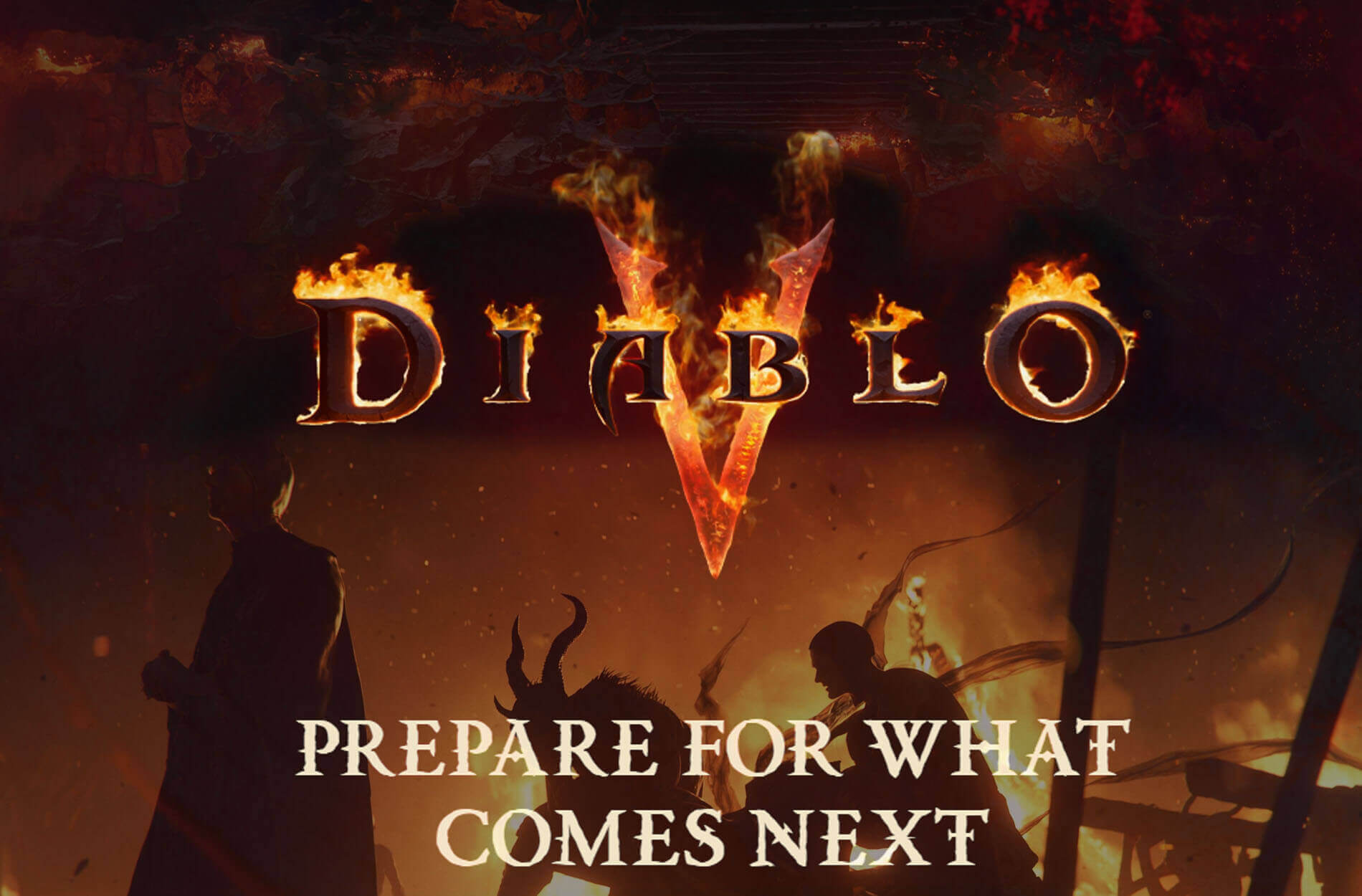 The most striking revelation from BlizzCon 2026 was the official announcement of Diablo V, slated for a Spring 2029 release. This instalment dramatically redefines the established narrative by positing a Sanctuary where Diablo has definitively triumphed. This narrative inversion shifts the player's experience from one of heroic defiance to one of survival in a fallen world. The central question posed to players, "what must you become when the world has already fallen?", suggests a darker, more introspective journey. This premise moves away from the typical hero's journey and delves into the grim realities of a world already claimed by evil, forcing players to adapt and find new forms of strength in desolation.
The world of Diablo V will not be the Sanctuary players have come to know. Traditional static towns will be replaced by a mobile caravan system, where player progression and movement are intrinsically linked to their nomadic existence as the Heir to Westmarch. This mechanic promises a fresh approach to exploration and base building, reflecting the pervasive instability of a world under demonic rule. Furthermore, the initial class reveals—the Demon Hunter, the Monk, and the all-new Plague Knight—hint at gameplay styles that will adapt to this new reality. The inclusion of the Plague Knight, in particular, suggests a focus on unconventional and perhaps morally ambiguous tactics necessary for survival. You can also sign up for future updates at Diablo5.Blizzard.com.
The most striking revelation from BlizzCon 2026 was the official announcement of Diablo V, slated for a Spring 2029 release. This instalment dramatically redefines the established narrative by positing a Sanctuary where Diablo has definitively triumphed. This narrative inversion shifts the player's experience from one of heroic defiance to one of survival in a fallen world. The central question posed to players, "what must you become when the world has already fallen?", suggests a darker, more introspective journey. This premise moves away from the typical hero's journey and delves into the grim realities of a world already claimed by evil, forcing players to adapt and find new forms of strength in desolation.
The world of Diablo V will not be the Sanctuary players have come to know. Traditional static towns will be replaced by a mobile caravan system, where player progression and movement are intrinsically linked to their nomadic existence as the Heir to Westmarch. This mechanic promises a fresh approach to exploration and base building, reflecting the pervasive instability of a world under demonic rule. Furthermore, the initial class reveals—the Demon Hunter, the Monk, and the all-new Plague Knight—hint at gameplay styles that will adapt to this new reality. The inclusion of the Plague Knight, in particular, suggests a focus on unconventional and perhaps morally ambiguous tactics necessary for survival. You can also sign up for future updates at Diablo5.Blizzard.com.
Revisiting Classic Mechanics and Continued Support for Diablo IV
Diablo V’s itemization and systems are set to draw heavily from the beloved mechanics of Diablo II. Players can anticipate the return of stat requirements for gear, the strategic depth of inventory grid space where item size matters, and the power of sets, Runes, and Runewords. This embrace of classic design principles aims to recapture the intricate loot progression and build diversity that defined earlier entries in the series, resonating with long-time fans while introducing these engaging systems to a new generation of players. Crucially, Blizzard has committed to maintaining robust support for Diablo IV alongside the development of Diablo V. The 2027 arrival of the Amazon Class Pack for Diablo IV exemplifies this dedication, ensuring that the current game world continues to receive fresh content and exciting updates. This dual approach signifies a significant commitment to the Diablo universe, allowing players to engage with both a familiar, evolving experience and a groundbreaking new chapter. The confirmation that Diablo IV will also be coming to the Nintendo Switch™ 2 further broadens its accessibility and player base, demonstrating a strategy to keep the franchise thriving across multiple platforms and titles. The Season of Hell’s Legacy also adds another layer of ongoing engagement within Diablo IV, ensuring the world of Sanctuary remains vibrant and full of challenges. ↑ Back to TopDiablo IV on Nintendo Switch™ 2
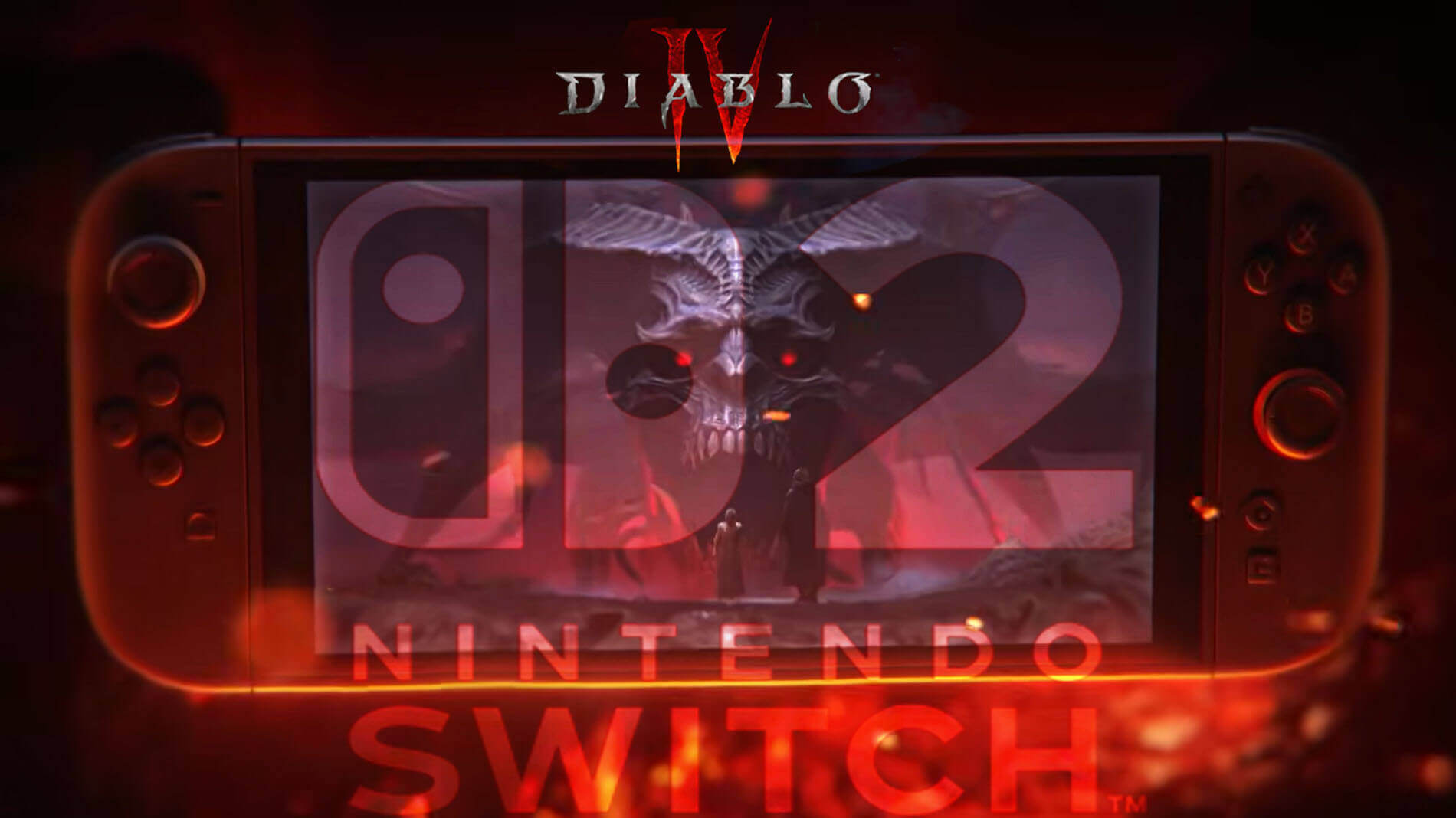 The primary concern for any demanding game making its debut on a portable console is its ability to perform adequately. Diablo IV, with its visually rich environments, complex character models, and intense real-time combat, presents a considerable technical challenge. However, the Nintendo Switch™ 2, rumoured to possess significantly more processing power than its predecessor, is anticipated to be capable of handling such a title. Developers at Blizzard Entertainment have a history of optimizing their games for a wide range of hardware, and the technical specifications of the Switch™ 2, while not officially revealed, are widely expected to bridge the gap between current-generation consoles and the previous generation.
The key to a successful port will lie in Blizzard’s optimization efforts. This will likely involve careful management of graphical fidelity, frame rates, and loading times. Players can expect a visual experience that, while perhaps not reaching the absolute peak of what a high-end PC or current generation console can achieve, will be faithful to the art style and atmosphere of Diablo IV. Textures may be slightly downscaled, lighting effects might be simplified, and certain particle effects could be less dense. However, the core gameplay loop, the visceral combat, and the atmospheric world of Sanctuary should remain intact. The Switch™ 2’s potential for hardware upscaling technologies, similar to those found on other modern platforms, could also play a crucial role in maintaining a sharp and visually pleasing image on both handheld and docked modes.
Furthermore, the inclusion of the Vessel of Hatred and Lord of Hatred expansions means that the Switch™ 2 will be the platform to receive the complete Diablo IV narrative and content arc. This is a significant undertaking, as these expansions are expected to introduce substantial new areas, story content, and gameplay mechanics. Blizzard's commitment to delivering this full experience underscores the perceived capabilities of the Switch™ 2. The success of the port will hinge on Blizzard’s ability to strike a balance between visual quality and smooth, responsive gameplay, ensuring that the demanding nature of Diablo IV does not detract from the player's immersion and enjoyment. The potential for dynamic resolution scaling, a common technique in modern game development, will be crucial in maintaining a consistent frame rate during hectic combat encounters, which are a hallmark of the Diablo series.
The primary concern for any demanding game making its debut on a portable console is its ability to perform adequately. Diablo IV, with its visually rich environments, complex character models, and intense real-time combat, presents a considerable technical challenge. However, the Nintendo Switch™ 2, rumoured to possess significantly more processing power than its predecessor, is anticipated to be capable of handling such a title. Developers at Blizzard Entertainment have a history of optimizing their games for a wide range of hardware, and the technical specifications of the Switch™ 2, while not officially revealed, are widely expected to bridge the gap between current-generation consoles and the previous generation.
The key to a successful port will lie in Blizzard’s optimization efforts. This will likely involve careful management of graphical fidelity, frame rates, and loading times. Players can expect a visual experience that, while perhaps not reaching the absolute peak of what a high-end PC or current generation console can achieve, will be faithful to the art style and atmosphere of Diablo IV. Textures may be slightly downscaled, lighting effects might be simplified, and certain particle effects could be less dense. However, the core gameplay loop, the visceral combat, and the atmospheric world of Sanctuary should remain intact. The Switch™ 2’s potential for hardware upscaling technologies, similar to those found on other modern platforms, could also play a crucial role in maintaining a sharp and visually pleasing image on both handheld and docked modes.
Furthermore, the inclusion of the Vessel of Hatred and Lord of Hatred expansions means that the Switch™ 2 will be the platform to receive the complete Diablo IV narrative and content arc. This is a significant undertaking, as these expansions are expected to introduce substantial new areas, story content, and gameplay mechanics. Blizzard's commitment to delivering this full experience underscores the perceived capabilities of the Switch™ 2. The success of the port will hinge on Blizzard’s ability to strike a balance between visual quality and smooth, responsive gameplay, ensuring that the demanding nature of Diablo IV does not detract from the player's immersion and enjoyment. The potential for dynamic resolution scaling, a common technique in modern game development, will be crucial in maintaining a consistent frame rate during hectic combat encounters, which are a hallmark of the Diablo series.
The Nintendo Switch™ 2 Advantage: Portability and Versatility
The most compelling aspect of Diablo IV coming to the Nintendo Switch™ 2 is the unparalleled portability it offers. The Diablo series, at its core, is about player progression, loot hunting, and engaging in visceral combat. These elements are inherently suited to both dedicated gaming sessions and quick, on-the-go play. The Switch™ 2’s hybrid nature allows players to experience the dark, atmospheric world of Sanctuary in their living rooms, connected to a television, or to take their adventures with them wherever they go. This versatility broadens the accessibility of Diablo IV significantly. Imagine continuing a dungeon crawl on a commute, engaging in a boss fight during a lunch break, or simply diving into the game for a few minutes of demon slaying before bed. This level of freedom is something that traditional home consoles cannot replicate. The Switch™ 2’s docking capability ensures that players can seamlessly transition from handheld play to a more traditional console-like experience, offering flexibility to suit different environments and preferences. The portability factor is not just a convenience; it’s a paradigm shift in how players can engage with a game like Diablo IV. It allows for a more integrated gaming experience into daily life, catering to a wider audience with diverse schedules and playstyles. This adaptability is a key selling point for the Switch™ 2 and a significant draw for a game that can be both deeply engrossing and satisfying in shorter bursts. The Switch™ 2’s unique controller options, particularly the Joy-Con™ controllers, can be adapted to provide various control schemes. While the prompt specifically notes that Joy-Con™ mouse functionality is not supported, the traditional analogue stick and button layout will likely offer a robust and intuitive control experience. For those who prefer a more precise input method, the mention of USB mouse and keyboard support is a game-changer. This feature, if implemented effectively, would allow players to experience Diablo IV with a level of control reminiscent of PC gaming, bringing a highly sought-after precision to the console environment. This dual approach to input – the flexibility of controllers and the precision of mouse and keyboard – ensures that Diablo IV on the Switch™ 2 can cater to a broad spectrum of player preferences, making it a truly versatile platform for the game.The Age of Hatred Collection: A Comprehensive Offering
The Diablo IV: Age of Hatred Collection’s inclusion of the base game and both the Vessel of Hatred and Lord of Hatred expansions is a strategic masterstroke. For new players discovering Diablo IV on the Switch™ 2, this collection provides immediate access to the complete narrative and the full breadth of content. They will not be left wanting for more, able to experience the unfolding story of Lilith’s return and the subsequent conflicts without needing to purchase additional content. This comprehensive approach is particularly appealing on a platform where players might be accustomed to more self-contained experiences or where the acquisition of multiple digital purchases might feel more involved. For returning players who may have played Diablo IV on other platforms, the Switch™ 2 version offers a new way to re-experience the game and its expansions. The portability and the unique control options present a fresh perspective on Sanctuary. The anticipation for Vessel of Hatred, which is set to delve into the dark jungles of Nahantu, and the subsequent Lord of Hatred expansion, which promises to further expand the lore and challenges of the world, means that the Switch™ 2 launch is not just about bringing an existing game to a new platform, but about delivering the evolving, living narrative of Diablo IV from its inception through its future expansions. This bundled approach also simplifies the purchasing decision for consumers. Instead of navigating a tiered release strategy, players know they are getting the definitive Diablo IV experience right out of the gate. This is particularly beneficial for a game like Diablo IV, which is characterized by its deep lore, extensive gameplay mechanics, and ongoing content updates. The inclusion of expansions ensures that players can immerse themselves fully in the world and its evolving story without interruption. The promise of exploring new regions and confronting new evils alongside the core narrative offers a compelling reason for players to engage with Diablo IV on the Switch™ 2, whether they are newcomers or long-time fans seeking a portable sanctuary from the horrors of hell.Player Experience and the Appeal of Mouse and Keyboard Support
The player experience on any platform is paramount, and for Diablo IV on the Switch™ 2, it is poised to be a unique blend of familiar gameplay and novel interaction. The core mechanics of Diablo IV—fast-paced combat, intricate skill trees, deep loot customization, and a compelling narrative—are expected to translate well to the Switch™ 2’s hardware. The action RPG genre thrives on responsive controls and clear visual feedback, both of which Blizzard has consistently delivered. The true differentiator, however, lies in the platform’s input versatility. The standard controller setup, utilizing analogue sticks and buttons, will likely offer an accessible and enjoyable experience for most players. Blizzard has proven adept at adapting Diablo’s gameplay to various control schemes, and the Switch™ 2’s controllers should provide a fluid and engaging way to engage in combat and navigate menus. The ability to detach the Joy-Con™ controllers for individual use or to employ a Pro Controller will further enhance comfort and control for different playstyles. However, the mention of USB mouse and keyboard support is particularly noteworthy. For a game that originated on PC and has historically benefited from the precision of mouse-based aiming and targeting, this feature is a significant advantage. Players who are accustomed to the intricate control offered by a mouse and keyboard will be able to replicate that experience on their Switch™ 2, whether docked to a TV or on their desk. This could mean more accurate spellcasting, more precise movement during intense battles, and a generally more refined control scheme for players who prioritize it. This ability to connect a USB mouse and keyboard directly to the Switch™ 2, without the need for complex adapters or workarounds, significantly lowers the barrier to entry for PC-like control on a console. This feature will likely appeal to a core demographic of Diablo fans who may already own the game on PC but are tempted by the portability of the Switch™ 2. It offers a way to bridge the gap between the two experiences, providing the best of both worlds: the freedom of a portable console and the precision of traditional PC controls. The prompt’s explicit note that Joy-Con™ mouse functionality is not supported is a clear indication that the developers are focusing on providing a robust, dedicated mouse and keyboard experience via USB, acknowledging the limitations of the Joy-Cons for such precise input. ↑ Back to TopMore Diablo Panels at BlizzCon 2026
Forging the Future: The Promise of Diablo V
The "Diablo V: Forging the Future" panel, scheduled for the main stage, represents the most significant reveal of the event. Hosting Johanna Faries, a prominent figure within Blizzard's leadership, alongside the Diablo V development team, signals a deliberate effort to convey a clear and confident vision for the franchise's next major instalment. The focus on an "early preview" of the game's "story, world-building approach, class design philosophy, and the vision that will define the next era for Diablo" suggests a foundational presentation. This indicates that the core pillars of Diablo V are being solidified, and Blizzard is eager to share this direction with its most dedicated audience. The emphasis on story and world building is particularly noteworthy. Diablo's lore, steeped in the eternal conflict between the High Heavens and the Burning Hells, has always been a driving force behind player engagement. A deep dive into the narrative direction of Diablo V implies a commitment to expanding this rich tapestry, potentially exploring new regions of Sanctuary, introducing novel theological or demonic concepts, or even reinterpreting established mythos. World building, in this context, extends beyond mere environmental design; it encompasses the creation of a believable and immersive setting that players can inhabit and explore. The success of Diablo IV, for instance, was significantly bolstered by its meticulously crafted, atmospheric open world. Therefore, understanding the "world-building approach" for Diablo V is crucial to gauging its potential for immersive gameplay. The inclusion of "class design philosophy" highlights a critical element of Diablo's gameplay loop. The distinct playstyles and abilities offered by each class are fundamental to the series' re-playability and player expression. Discussing the philosophy behind Diablo V's classes suggests a thoughtful approach to innovation, balancing the desire to introduce fresh mechanics with the need to retain the iconic feel of Diablo's archetypes. This could involve entirely new classes, significant reworks of existing ones, or the introduction of deeper customization options within established class structures. The "vision that will define the next era for Diablo" is the overarching promise, suggesting that Diablo V is not merely a sequel but a transformative step for the franchise, aiming to redefine player expectations and set new benchmarks for the action RPG genre. This panel serves as the cornerstone of BlizzCon 2026's Diablo presence, setting the stage for what players can anticipate in the years to come.The Art of Darkness: Visual Storytelling in Diablo IV
Complementing the forward-looking glimpse of Diablo V, the "The Art of Darkness: Behind D4's Cinematics" panel offers a deep appreciation for the artistic achievements of its predecessor. Focusing on Diablo IV's cinematic team, this session delves into the intricate craft behind the game's "visual storytelling, performance, animation, and craft." In an era where game cinematics are increasingly sophisticated, this panel acknowledges the critical role they play in immersing players in the narrative and establishing the game's tone. The "behind the scenes" aspect of this panel promises an intimate look at the creative process. Understanding "visual storytelling" in this context means exploring how the team uses composition, lighting, and camera work to convey emotion and advance the plot without relying solely on dialogue. "Performance" refers to the motion capture and voice acting that breathe life into characters, making their struggles and triumphs resonate with players. The "animation" aspect delves into the meticulous frame by frame work that brings monsters, heroes, and environments to life, from the subtle twitch of a demon's claw to the sweeping grandeur of a cinematic sequence. Finally, the "craft behind Sanctuary's darkest moments" encapsulates the holistic effort involved in creating the game's signature gothic aesthetic. This includes everything from character modelling and environmental art to the subtle nuances of particle effects that contribute to the oppressive atmosphere. Diablo IV's critical acclaim was, in no small part, attributed to its stunning visual presentation and compelling narrative delivery through its cutscenes. This panel serves as a testament to that achievement, allowing fans to gain a deeper understanding and appreciation for the artistic talent involved. It also reinforces Blizzard's commitment to high production values, demonstrating that even between major game releases, the dedication to artistic excellence remains a core tenet. For aspiring artists and storytellers, this panel offers valuable insights into the professional practices and creative considerations that go into producing AAA game cinematics. It celebrates the tangible beauty and emotional impact that can be achieved through a mastery of visual media within the interactive realm.Cross-Over Appeal and Creative Collaboration: Diablo Immortal and Spawn
The "Summoning Spawn into Diablo Immortal: Live Drawing with Todd McFarlane" panel represents a strategic and exciting move for Diablo Immortal, leveraging the power of established cultural icons to broaden its appeal and engage a new segment of the player base. The collaboration with "legendary comic creator Todd McFarlane" is a significant draw, tapping into the immense popularity of his creation, Spawn. This panel is framed as a celebration, blending the worlds of "Spawn and Sanctuary" through a live drawing session. The involvement of Todd McFarlane himself signifies a genuine partnership and an understanding of the synergy between visually driven mediums. Watching him collaborate with "Diablo Immortal Senior Artist Justin Murray" on "original artwork in real time" offers a unique spectacle. This live creation process provides viewers with an immediate and engaging demonstration of artistic skill and conceptualization. More importantly, it allows for a discussion of the "creative process behind the collaboration," offering insight into how two distinct artistic visions can merge. This could involve exploring the challenges of translating Spawn's iconic design into Diablo's aesthetic or how the Diablo universe might influence McFarlane's artistic choices in this context. The "insights into bringing one of comics' most iconic antiheroes to Diablo Immortal" is the key takeaway. This suggests that Spawn will not just be a visual cameo but an integrated element within Diablo Immortal, likely in the form of a character skin, a themed event, or perhaps even a temporary companion. This type of cross-promotional collaboration is a powerful tool for marketing and player acquisition, introducing Diablo Immortal to McFarlane's existing fanbase and vice versa. It also showcases Blizzard's willingness to experiment and engage with other creative industries, acknowledging the cross-pollination of popular culture. This panel underscores Diablo Immortal's role as a platform for unique experiences and a testament to the enduring power of iconic characters to transcend their original mediums.Celebrating Legacy and Introducing the Amazon: Diablo IV's Evolving Future
The "Diablo IV: What's Next" panel on Sunday is a crucial touchpoint for the ongoing development and expansion of Diablo IV, explicitly tying into the franchise's "30 years of darkness" anniversary. This panel aims to serve a dual purpose: to celebrate the series' rich history and to provide concrete updates on Diablo IV's future content. The "world premiere of the Season of Hell's Legacy gameplay trailer" is a significant event, offering players their first visual glimpse into the next major content update. The "deep dive into the upcoming season that is inspired by iconic moments from across Diablo's history" is particularly compelling. This approach to content creation demonstrates a thoughtful engagement with the franchise's legacy. By drawing inspiration from thirty years of lore, gameplay mechanics, and memorable events, Blizzard aims to create a season that resonates with long serving fans while also introducing new players to the depth of Diablo's past. This could manifest in various ways, such as thematic enemy types, dungeons referencing classic locations, or even lore-heavy quests that retell or reimagine pivotal moments from earlier titles. This strategy not only celebrates the anniversary but also ensures that Diablo IV remains a living, evolving narrative that acknowledges its lineage. The reveal of "the next class coming to Diablo: The Amazon" is another major highlight. The Amazon is a fan-favourite from Diablo II, known for her javelins, spears, and other ranged combat abilities. Her reintroduction into Diablo IV signifies a strategic choice to bring back beloved elements while likely infusing them with modern design and gameplay enhancements. The panel promises an "early look," suggesting players will see initial gameplay demonstrations, understand the class's core mechanics, and begin to anticipate how she will fit into the current Diablo IV meta. This announcement is bound to generate significant excitement and discussion within the community, as class choice is a fundamental aspect of the Diablo experience. This panel effectively bridges the past and the future of Diablo IV, offering both nostalgic reflection and exciting new content.The Unseen Voices: A Look at Character Performance
The "Voice Actors' Panel" is a unique and valuable addition to the BlizzCon schedule, offering a more intimate and human perspective on the creation of the Diablo experience. By bringing together the "voices behind beloved Blizzard characters," this panel focuses on the often-unsung heroes of game development. The promise to "hear stories from the booth, revisit memorable performances, and bring favourite moments to life on stage" creates an opportunity for fans to connect with the talent that imbues virtual characters with personality and emotion. "Stories from the booth" will likely offer anecdotes about the recording process, the challenges of portraying complex characters, and the collaborative environment of voice acting sessions. This can provide a fascinating glimpse into the creative process that goes beyond the visual and mechanical aspects of gameplay. "Revisiting memorable performances" allows for a retrospective appreciation of iconic vocal deliveries that have defined characters and resonated with players for years. This can involve actors discussing their interpretations, their favourite lines, or the emotional impact of certain scenes. Finally, the ability to "bring favourite moments to life on stage" suggests interactive elements, perhaps through live readings of dialogue snippets or vocal improvisations, further immersing the audience in the characters they know and love. The mention of the panel being "Simulcast on YouTube.com/Blizzard or Twitch.tv/Blizzard" is crucial. This indicates Blizzard's understanding of its global audience and its commitment to making such content accessible to those who cannot attend BlizzCon in person. This broadens the reach of the panel, allowing a wider community to engage with the artistry of voice acting. In a franchise like Diablo, where atmosphere and character immersion are paramount, the voices of its cast play an indispensable role in creating that dark and compelling world. This panel offers a well-deserved spotlight on their contributions, adding another layer of appreciation for the craftsmanship that defines the Diablo universe. ↑ Back to TopDiablo 3 Season 40 Preview
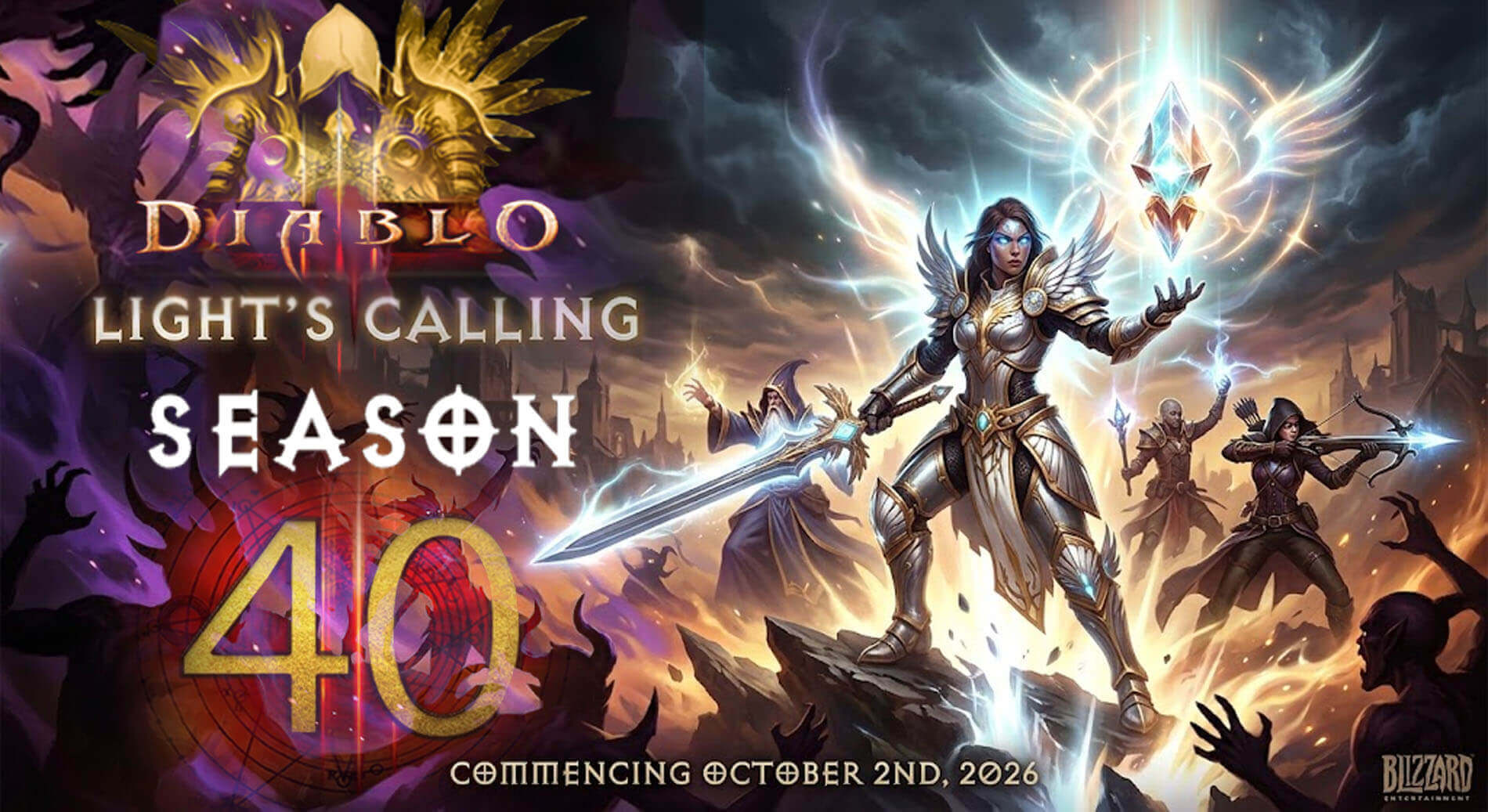 The world of Sanctuary, a realm perpetually teetering on the brink of annihilation, is once again preparing for a new era of conflict and celestial intervention. Blizzard Entertainment has announced Diablo 3 Season 40, titled "Light's Calling," set to commence on October 2nd, 2026. This season revisits a thematic element that first graced players in Season 27, promising a renewed focus on the divine energies and the Nephalem's role in wielding them. With the conclusion of Season 39 on September 27th, players will soon have the opportunity to embrace the power of the High Heavens, seeking to tip the scales in the eternal war between light and darkness.
Season 40's "Light's Calling" theme is rooted in a narrative where the Angels of the High Heavens have actively participated in bolstering Sanctuary's defences. Recognizing the Nephalem's inherent power and their tireless efforts against infernal forces, the celestial beings have bestowed upon them a "token of their righteousness." This isn't a passive blessing; rather, it involves an "angelic trial" where Nephalem must demonstrate their worthiness. Through this process, a symbol of their morality is crystallized into "pure, otherworldly perfection." The exact nature of the celestial force imbued within remains a mystery, an enticing question for players to unravel on the battlefield. This approach empowers players, transforming them from mere combatants into active participants in a cosmic struggle, where their actions and inherent morality are directly linked to their burgeoning power.
The world of Sanctuary, a realm perpetually teetering on the brink of annihilation, is once again preparing for a new era of conflict and celestial intervention. Blizzard Entertainment has announced Diablo 3 Season 40, titled "Light's Calling," set to commence on October 2nd, 2026. This season revisits a thematic element that first graced players in Season 27, promising a renewed focus on the divine energies and the Nephalem's role in wielding them. With the conclusion of Season 39 on September 27th, players will soon have the opportunity to embrace the power of the High Heavens, seeking to tip the scales in the eternal war between light and darkness.
Season 40's "Light's Calling" theme is rooted in a narrative where the Angels of the High Heavens have actively participated in bolstering Sanctuary's defences. Recognizing the Nephalem's inherent power and their tireless efforts against infernal forces, the celestial beings have bestowed upon them a "token of their righteousness." This isn't a passive blessing; rather, it involves an "angelic trial" where Nephalem must demonstrate their worthiness. Through this process, a symbol of their morality is crystallized into "pure, otherworldly perfection." The exact nature of the celestial force imbued within remains a mystery, an enticing question for players to unravel on the battlefield. This approach empowers players, transforming them from mere combatants into active participants in a cosmic struggle, where their actions and inherent morality are directly linked to their burgeoning power.
Angelic Crucibles and Class Specificity
The core gameplay mechanic introduced to facilitate this theme is the "Angelic Crucibles." These are new consumable items that Nephalem can recover throughout their adventures. The true power of an Angelic Crucible lies in its ability to "Sanctify" any equip-able Legendary item. This sanctification process infuses the chosen item with one of three new class specific powers, selected at random. Blizzard's stated intention here is to "lean into the expertise of each class, further exemplifying its respective prowess, but through a nuanced lens." This suggests that the new powers will not be generic buffs, but rather enhancements that complement and amplify the unique playstyles and abilities already inherent to each of Sanctuary's distinct classes. For example, a Barbarian might receive a power that enhances their already formidable rage mechanics, while a Wizard could gain an ability that further manipulates arcane energies in novel ways. This focus on class identity is crucial for maintaining player engagement and ensuring that each character feels distinct and powerful in their own right, even as they tap into heavenly might. The inspiration for these new powers is drawn directly from the High Heavens themselves, described as a place of "ethereal splendour, bursting with boundless radiance." The developers aim to provide players with "a taste of untainted power as doled out from Heaven itself." This imagery evokes a sense of purity, divine intervention, and ultimate justice. By allowing players to harness these celestial forces, Season 40 offers a compelling narrative and gameplay loop that contrasts with the often grim and desperate battles fought against demons. The infusion of angelic power serves as a beacon of hope, a tangible representation of the ongoing war for the soul of Sanctuary. The randomized nature of the sanctified powers adds an element of surprise and replay-ability, encouraging players to experiment with different item combinations and adapt their strategies to best utilize their newly acquired celestial boons. This unpredictability ensures that each play session can feel fresh and exciting, as players strive to uncover the most potent and synergistic builds.A Symphony of Returning and New Cosmetics
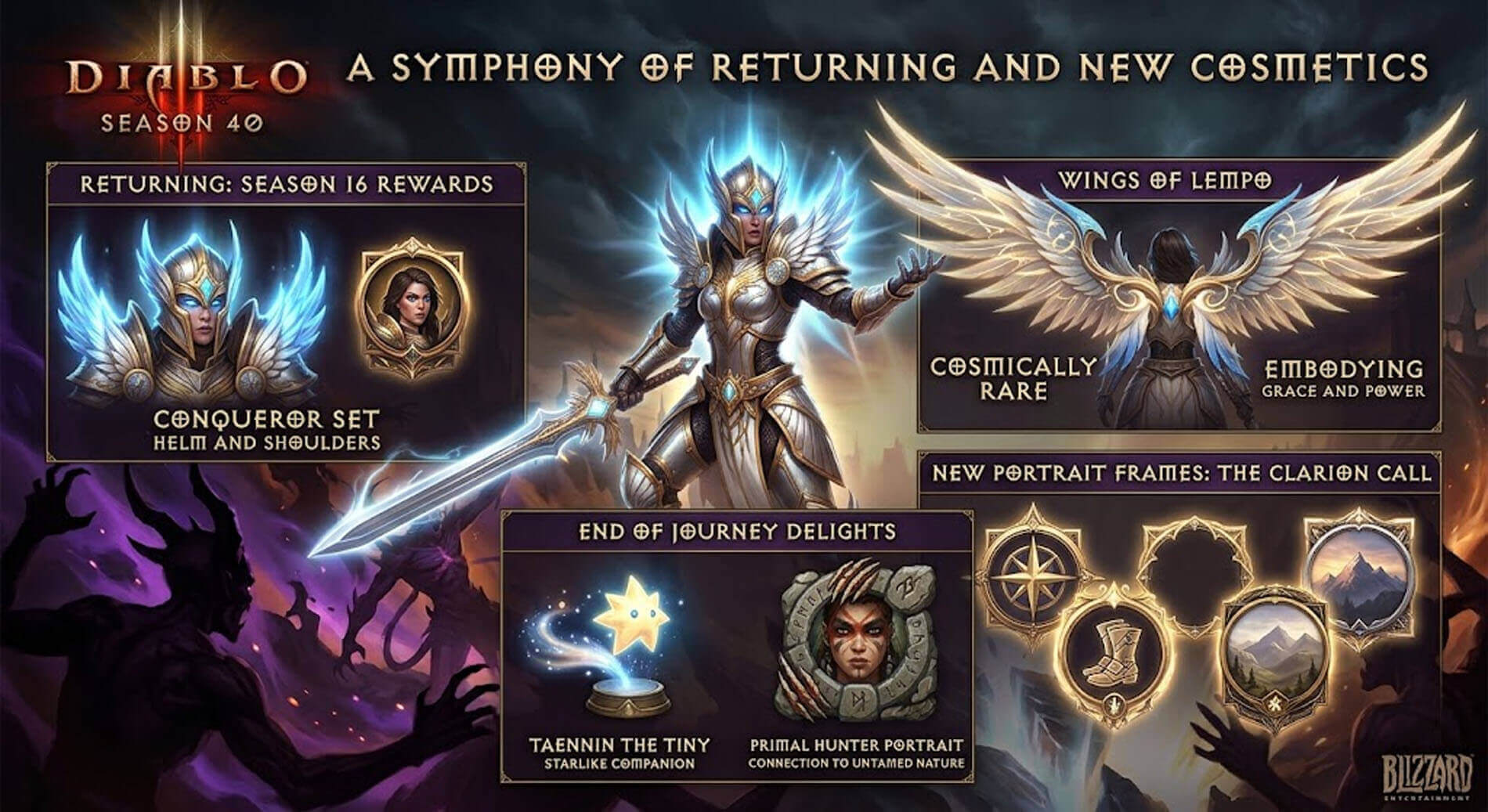 The core of Diablo 3 Season 40's appeal lies in its dual offering of familiar and novel cosmetic treasures. The decision to revisit Season 16 rewards is a strategic one, catering to players who may have joined the Diablo 3 community after that season concluded. The exclusive Conqueror Set, a staple for demonstrating seasonal dedication, returns with its iconic Helm and Shoulder slots available to those who conquer the season's objectives. This set not only signifies a player's commitment but also provides a tangible reward for their efforts, enhancing the visual identity of their characters. Beyond the Conqueror Set, Season 40 introduces a brand-new collection of portrait frames. These frames are thematically linked to the "clarion call of adventure," evoking a sense of grand journeys and heroic undertakings within Sanctuary. Such frames serve as a subtle yet impactful way for players to express their engagement with the season's narrative and their own in game achievements.
However, the true showstopper of Season 40's cosmetic offerings, particularly for dedicated collectors, are the Wings of Lempo. These wings are described as drawing inspiration from the "noblest creatures in Sanctuary," hinting at a design that embodies grace, power, and perhaps a touch of celestial majesty. The mention of them being "cosmically rare" and possessing a beauty few other wings can match suggests a highly sought after item, one that will undoubtedly become a status symbol within the game. This focus on unique, visually striking items like the Wings of Lempo is crucial for maintaining player interest and rewarding long term engagement. The developers have consistently understood that in a game where character power is often reset with each new season, cosmetic rewards offer a lasting sense of accomplishment and individual expression.
Complementing the primary cosmetic rewards, Season 40 also presents two new "End of Journey" items, providing further incentive for players to complete their seasonal endeavours. These rewards are designed to be visually distinct and thematically resonant, offering a final flourish for a season's worth of hard work. The Taennin the Tiny pet is introduced as a shimmering, starlike companion that leaves trails of pure light in its wake. This description conjures an image of ethereal beauty and subtle magical presence, a pet that would undoubtedly add a touch of wonder to a player's adventures. Pets in Diablo 3 serve not only as companions but also as visual extensions of a player's character, adding another layer of personalization.
The second End of Journey reward taps into a different aesthetic: the Primal Hunter portrait. While the description is brief, the name itself suggests a connection to the raw, untamed forces of nature within Diablo 3's world. This could manifest as a portrait frame inspired by primal beasts, ancient energies, or the untamed wilderness of Sanctuary. The contrast between the celestial Taennin the Tiny and the primal Primal Hunter offers a balanced appeal, catering to different player preferences for visual themes. These dual rewards ensure that a wider range of players will find something to their liking, reinforcing the season's overall value proposition. The inclusion of such distinct items at the end of the journey provides a satisfying culmination to the seasonal experience, encouraging players to push through to the very end.
↑ Back to Top
The core of Diablo 3 Season 40's appeal lies in its dual offering of familiar and novel cosmetic treasures. The decision to revisit Season 16 rewards is a strategic one, catering to players who may have joined the Diablo 3 community after that season concluded. The exclusive Conqueror Set, a staple for demonstrating seasonal dedication, returns with its iconic Helm and Shoulder slots available to those who conquer the season's objectives. This set not only signifies a player's commitment but also provides a tangible reward for their efforts, enhancing the visual identity of their characters. Beyond the Conqueror Set, Season 40 introduces a brand-new collection of portrait frames. These frames are thematically linked to the "clarion call of adventure," evoking a sense of grand journeys and heroic undertakings within Sanctuary. Such frames serve as a subtle yet impactful way for players to express their engagement with the season's narrative and their own in game achievements.
However, the true showstopper of Season 40's cosmetic offerings, particularly for dedicated collectors, are the Wings of Lempo. These wings are described as drawing inspiration from the "noblest creatures in Sanctuary," hinting at a design that embodies grace, power, and perhaps a touch of celestial majesty. The mention of them being "cosmically rare" and possessing a beauty few other wings can match suggests a highly sought after item, one that will undoubtedly become a status symbol within the game. This focus on unique, visually striking items like the Wings of Lempo is crucial for maintaining player interest and rewarding long term engagement. The developers have consistently understood that in a game where character power is often reset with each new season, cosmetic rewards offer a lasting sense of accomplishment and individual expression.
Complementing the primary cosmetic rewards, Season 40 also presents two new "End of Journey" items, providing further incentive for players to complete their seasonal endeavours. These rewards are designed to be visually distinct and thematically resonant, offering a final flourish for a season's worth of hard work. The Taennin the Tiny pet is introduced as a shimmering, starlike companion that leaves trails of pure light in its wake. This description conjures an image of ethereal beauty and subtle magical presence, a pet that would undoubtedly add a touch of wonder to a player's adventures. Pets in Diablo 3 serve not only as companions but also as visual extensions of a player's character, adding another layer of personalization.
The second End of Journey reward taps into a different aesthetic: the Primal Hunter portrait. While the description is brief, the name itself suggests a connection to the raw, untamed forces of nature within Diablo 3's world. This could manifest as a portrait frame inspired by primal beasts, ancient energies, or the untamed wilderness of Sanctuary. The contrast between the celestial Taennin the Tiny and the primal Primal Hunter offers a balanced appeal, catering to different player preferences for visual themes. These dual rewards ensure that a wider range of players will find something to their liking, reinforcing the season's overall value proposition. The inclusion of such distinct items at the end of the journey provides a satisfying culmination to the seasonal experience, encouraging players to push through to the very end.
↑ Back to Top
The Spectrum of Seasonal Challenges
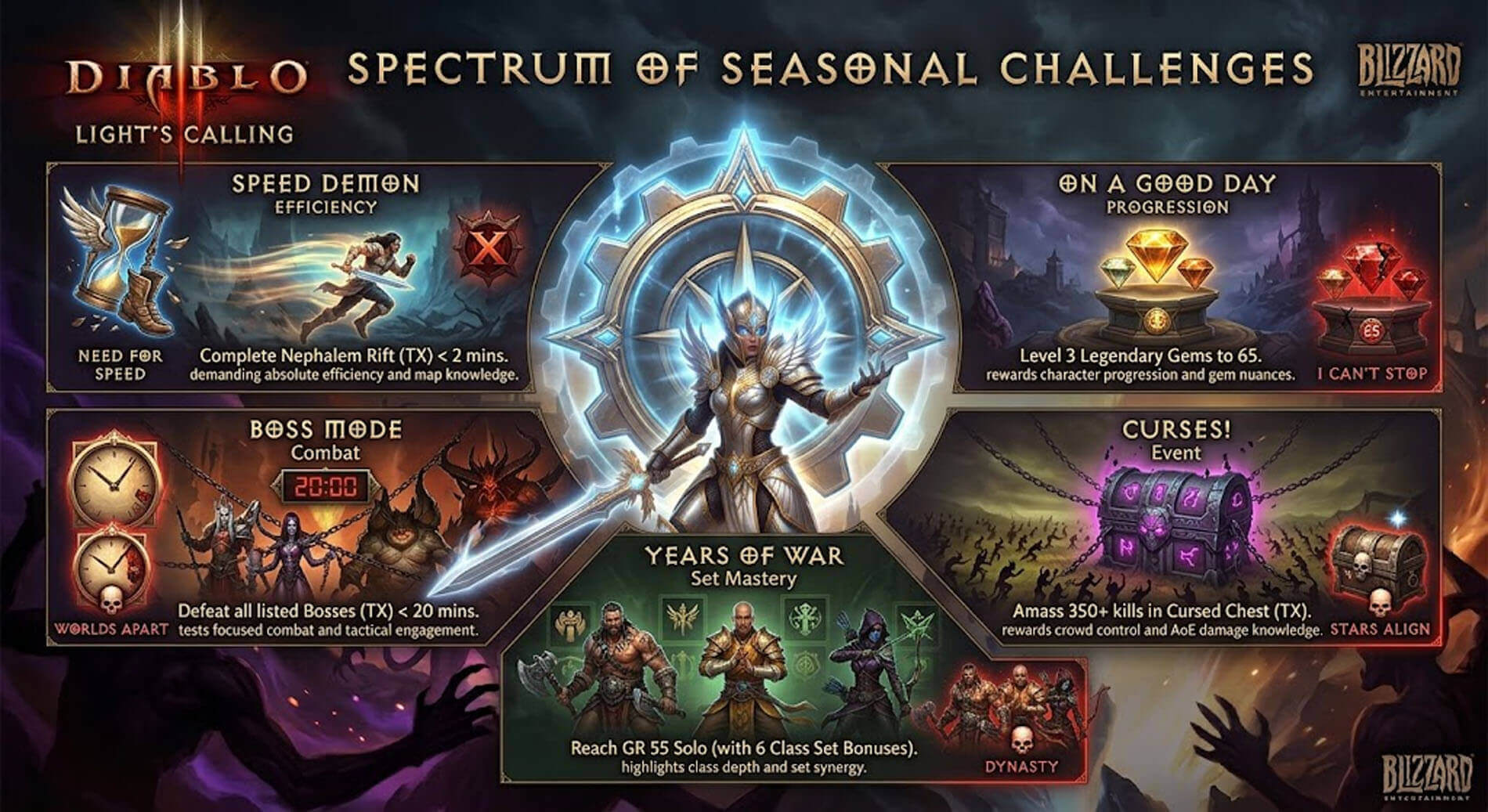 The returning Conquests for Diablo 3 Season 40 represent a carefully chosen cross-section of Diablo 3's gameplay pillars. "Speed Demon" and its Hardcore counterpart "Need for Speed" demand absolute efficiency. Completing a Nephalem Rift at the maximum level on Torment X difficulty within two minutes requires not only a powerful, optimized character build but also a deep understanding of rift layouts and monster spawn points. Players must meticulously plan their routes, exploit monster density, and utilize abilities that allow for rapid clearing and swift movement. This Conquest appeals to those who enjoy the thrill of optimizing their gameplay for pure speed and precision.
In contrast, "On a Good Day" and its Hardcore variant "I Can't Stop" focus on character progression and the meticulous cultivation of power. Levelling three Legendary Gems to level 65 is a more gradual pursuit, rewarding consistent play and strategic gem selection. This Conquest encourages players to engage with the Greater Rift system, experiment with different gem combinations to suit their build, and understand the nuances of gem levelling. It offers a more relaxed pace compared to speed challenges, allowing players to savour the journey of augmenting their character's power.
The "Boss Mode" and "Worlds Apart" Conquests present a distinct challenge centred on focused combat and time management. The objective is to defeat a specific list of bosses within twenty minutes at Torment X difficulty. This necessitates a build capable of bursting down high-health targets quickly and efficiently. Players must not only know the boss mechanics but also have the necessary damage output to achieve the time limit. It's a test of both raw power and tactical boss engagement, requiring players to have a robust endgame character that can handle diverse elite and boss encounters.
"Curses!" and "Stars Align" add another layer by emphasizing monster killing within a specific type of event. Amassing 350 or more monsters in a Cursed Chest event at level 70 on Torment X requires players to actively seek out these events and strategically position themselves to maximize their kill counts. This Conquest rewards players who understand crowd control, area of effect damage, and the game's dynamic event systems. It encourages engagement with specific in-game activities that might otherwise be overlooked in a rush to complete Greater Rifts.
Finally, "Years of War" and its Hardcore counterpart "Dynasty" are designed to test the mastery of class sets. Reaching Greater Rift Level 55 solo with the bonuses of six class sets is a significant achievement that highlights the power and synergy of Diablo 3's core set mechanics. Players must explore different class sets, understand their unique playstyles and power spikes, and master the skills and gear necessary to push high Greater Rifts using these powerful bonuses. This Conquest is a testament to the depth of each class's design and the satisfaction of mastering its iconic sets.
The returning Conquests for Diablo 3 Season 40 represent a carefully chosen cross-section of Diablo 3's gameplay pillars. "Speed Demon" and its Hardcore counterpart "Need for Speed" demand absolute efficiency. Completing a Nephalem Rift at the maximum level on Torment X difficulty within two minutes requires not only a powerful, optimized character build but also a deep understanding of rift layouts and monster spawn points. Players must meticulously plan their routes, exploit monster density, and utilize abilities that allow for rapid clearing and swift movement. This Conquest appeals to those who enjoy the thrill of optimizing their gameplay for pure speed and precision.
In contrast, "On a Good Day" and its Hardcore variant "I Can't Stop" focus on character progression and the meticulous cultivation of power. Levelling three Legendary Gems to level 65 is a more gradual pursuit, rewarding consistent play and strategic gem selection. This Conquest encourages players to engage with the Greater Rift system, experiment with different gem combinations to suit their build, and understand the nuances of gem levelling. It offers a more relaxed pace compared to speed challenges, allowing players to savour the journey of augmenting their character's power.
The "Boss Mode" and "Worlds Apart" Conquests present a distinct challenge centred on focused combat and time management. The objective is to defeat a specific list of bosses within twenty minutes at Torment X difficulty. This necessitates a build capable of bursting down high-health targets quickly and efficiently. Players must not only know the boss mechanics but also have the necessary damage output to achieve the time limit. It's a test of both raw power and tactical boss engagement, requiring players to have a robust endgame character that can handle diverse elite and boss encounters.
"Curses!" and "Stars Align" add another layer by emphasizing monster killing within a specific type of event. Amassing 350 or more monsters in a Cursed Chest event at level 70 on Torment X requires players to actively seek out these events and strategically position themselves to maximize their kill counts. This Conquest rewards players who understand crowd control, area of effect damage, and the game's dynamic event systems. It encourages engagement with specific in-game activities that might otherwise be overlooked in a rush to complete Greater Rifts.
Finally, "Years of War" and its Hardcore counterpart "Dynasty" are designed to test the mastery of class sets. Reaching Greater Rift Level 55 solo with the bonuses of six class sets is a significant achievement that highlights the power and synergy of Diablo 3's core set mechanics. Players must explore different class sets, understand their unique playstyles and power spikes, and master the skills and gear necessary to push high Greater Rifts using these powerful bonuses. This Conquest is a testament to the depth of each class's design and the satisfaction of mastering its iconic sets.
Strategic Depth and Player Engagement
The variety of these Conquests ensures that Season 40 appeals to a wide range of player preferences. Some players thrive on the adrenaline of speed runs, while others enjoy the methodical progression of gem levelling. The inclusion of both speed and endurance challenges, along with those focused on specific combat scenarios and set mastery, creates a well-rounded seasonal experience. The Hardcore versions of these Conquests further raise the stakes, demanding even greater precision and risk management from players who choose to engage with them. This dual approach caters to both casual players seeking achievable goals and hardcore players looking for the ultimate test of their skills and dedication. The "Light's Calling" theme, while perhaps not directly tied to every Conquest's mechanics, contributes to the overall narrative and aesthetic of the season, enhancing player immersion and providing a thematic backdrop for their achievements. ↑ Back to TopHaedrig's Gift: A Seasonal Cornerstone
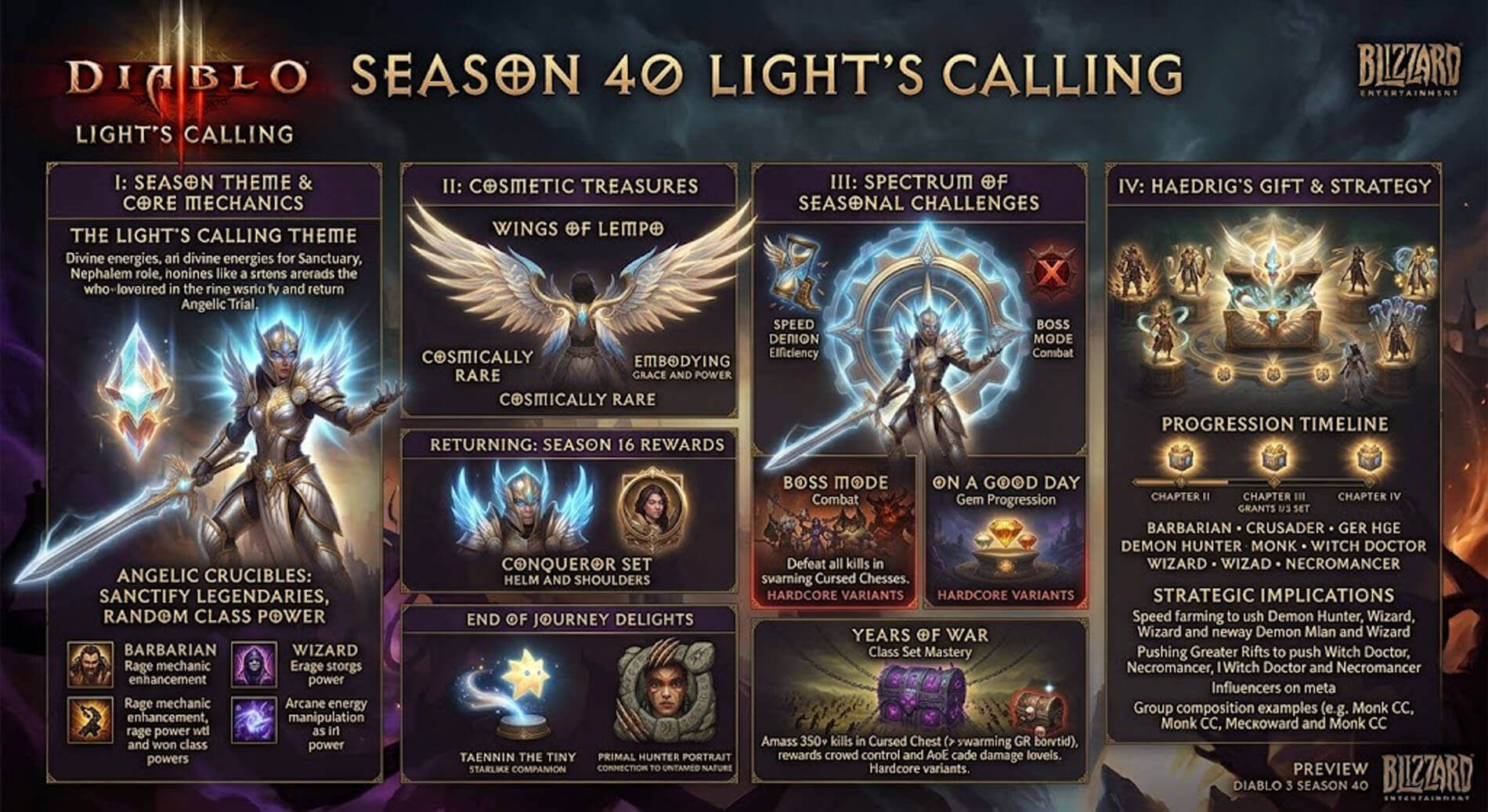 Haedrig's Gift is more than just a free handout; it is a carefully designed mechanic that injects strategic depth into the start of each Diablo 3 season. By completing the initial chapters of the Season Journey, players are rewarded with pieces of a powerful class set. This typically occurs over three stages, with Chapters II, III, and IV granting distinct parts of the set. The key advantage of this system is that it provides a significant power spike early on, allowing players to tackle higher difficulty levels and progress through the Season Journey at a much faster pace. Without Haedrig's Gift, the initial grind to acquire a full set could be prohibitively long and frustrating, potentially deterring newer players or those returning after a break. The choice of which character to open the gifts on is also a strategic decision, as only one full set can be obtained this way per season, making the selection of the first character paramount for early season power.
Diablo 3 Season 40's "Light's Calling" Class Set Lineup
Season 40's "Light's Calling" theme heralds the return of a familiar yet potent selection of class sets. For the Barbarian, the Horde of the Ninety Savages set promises a whirlwind of fury, empowering their seismic slams and shouts. Crusaders will find themselves donning the Aegis of Valor, a set often associated with powerful blessed shield and hammer of the righteous builds. The Demon Hunter's Gears of Dreadlands set typically focuses on rapid projectile attacks, making it an excellent choice for players who enjoy a fast-paced, ranged playstyle. Monks will receive the Patterns of Justice, a set that synergizes well with tempest rush and exploding palm, encouraging dynamic combat. The Witch Doctor's Mundunugu's Regalia set is renowned for its potent spirit barrage capabilities, allowing for significant damage from a distance. Wizards can look forward to Typhon's Veil, a set that often amplifies hydra skills, creating a devastating swarm of magical serpents. Finally, the Necromancer's Masquerade of the Burning Carnival set is a formidable choice, typically focusing on bone spear and corpse explosion mechanics, enabling gruesome and powerful displays of dark magic.Strategic Implications of the Gifted Sets
The specific sets available in Season 40 carry significant implications for player strategy. Sets like the Gears of Dreadlands for Demon Hunters or Typhon's Veil for Wizards often enable quick speed farming of Nephalem Rifts and Greater Rifts, making them prime candidates for players aiming to climb the leaderboards or acquire bounty materials efficiently. Conversely, sets that excel in pushing higher Greater Rift tiers, such as the Mundunugu's Regalia for Witch Doctors or the Masquerade of the Burning Carnival for Necromancers, might be favoured by players seeking the ultimate challenge. The choice of which class to focus on first directly influences the early season meta. If a particularly strong or "easy to play" set is available, many players will flock to that class, leading to a temporary surge in its popularity. This also affects the availability of group compositions, as a common strategy involves forming groups around powerful set bonuses. For instance, a group might prioritize having a player with the Patterns of Justice Monk for its crowd control and damage amplification capabilities.Panels, Twitch Drops and 30th Anniversary
 BlizzCon 2026 promises to be a landmark event for the Diablo franchise, marking its 30th anniversary with a blend of celebration and forward-looking reveals. This homecoming event for Blizzard Entertainment aims to unite the global Diablo community, both in person at the Anaheim Convention Centre and through online broadcasts.
The weekend is set to be packed with opportunities to delve into the dark lore of Sanctuary, understand the development process behind its iconic games, and anticipate what the future holds for the series. From major announcements during the opening ceremony to in-depth discussions with developers and artists, BlizzCon 2026 offers a comprehensive experience for every fan, whether they are attending physically or engaging remotely.
Channels for most Diablo broadcast content
BlizzCon 2026 promises to be a landmark event for the Diablo franchise, marking its 30th anniversary with a blend of celebration and forward-looking reveals. This homecoming event for Blizzard Entertainment aims to unite the global Diablo community, both in person at the Anaheim Convention Centre and through online broadcasts.
The weekend is set to be packed with opportunities to delve into the dark lore of Sanctuary, understand the development process behind its iconic games, and anticipate what the future holds for the series. From major announcements during the opening ceremony to in-depth discussions with developers and artists, BlizzCon 2026 offers a comprehensive experience for every fan, whether they are attending physically or engaging remotely.
Channels for most Diablo broadcast content
Diablo's Prominent Role at BlizzCon 2026
The Diablo franchise is poised to take a central role throughout BlizzCon 2026. The event kicks off with the Opening Ceremonies on Saturday, September 12, at 10:15 a.m. PT, were Johanna Faries, President of Blizzard Entertainment, will join franchise leaders to unveil significant game announcements. Diablo will undoubtedly be a focal point, with extensive plans for Sanctuary's future expected to be detailed. This ceremony, simulcast on YouTube and Twitch, will set the tone for the weekend, highlighting the enduring legacy and evolving narrative of the series. Following the opening, the Diablo team will host a "Developer Update" panel at 1:45 p.m. PT on the Main Stage. This session is designed to offer attendees a transparent look into the creative vision, development strategies, and overarching ambition that drives the Diablo franchise. It presents a valuable opportunity for players to gain insight into the intricate process of bringing the demonic world of Sanctuary to life and to understand the team's passion for the game. Later that day, at 4:15 p.m. PT, the Legends Stage will host "The Art of Darkness: Behind Diablo IV's Cinematics." This panel will feature members of the Diablo IV cinematic team, offering a deep dive into the artistry and technical prowess behind the game's visually stunning and narrative-driven cutscenes. Attendees will learn about the performance capture, animation, visual effects, and storytelling techniques employed to create some of Sanctuary's most memorable and impactful moments. This focus on cinematic presentation underscores Blizzard's commitment to immersive storytelling within the Diablo universe. Sunday, September 13, will continue the Diablo festivities, though specific panel details for this day are not yet fully outlined in the provided schedule. However, based on the event's structure, it is reasonable to expect further panels exploring gameplay, lore expansions, and community engagement initiatives, reinforcing the franchise's dedication to its player base.Engaging with the Diablo Community and Content
BlizzCon 2026 is designed to be accessible to fans worldwide. For those unable to attend in person, a significant portion of the Diablo broadcast content will be available through live streams on Diablo's official YouTube channel (youtube.com/Diablo) and Twitch channel (twitch.tv/Diablo). This ensures that the excitement and revelations are shared broadly, fostering a sense of collective experience. Beyond official broadcasts, BlizzCon often collaborates with a variety of content creators who play significant roles in the Diablo community. These partners typically provide their own unique perspectives, host watch parties, and offer supplementary content, enriching the overall fan experience. Details on participating creators are expected to be released closer to the event, providing fans with additional avenues to engage with the BlizzCon activities. The event will feature Twitch Drops, a popular system that rewards viewers for watching official BlizzCon streams. While specific rewards for Diablo-related content are yet to be announced, Twitch Drops have historically offered in-game items, cosmetic enhancements, or other valuable digital goods, serving as a tangible incentive for tuning in and celebrating the franchise.The Future of Sanctuary
BlizzCon 2026 serves as a crucial juncture for the Diablo franchise. Beyond commemorating three decades of demon-slaying, the event is a platform for Blizzard to articulate its vision for the future. The extensive plans for Sanctuary's evolution, hinted at during the Opening Ceremonies, suggest a commitment to ongoing development and innovation. Whether this involves new content for existing titles like Diablo IV, announcements regarding future expansions, or even glimpses of entirely new projects, the community can anticipate significant updates that will shape their journey through the dark world of Diablo for years to come. The convergence of nostalgia for the franchise's past and anticipation for its future promises an unforgettable BlizzCon experience.Diablo Immortal Live Artist Drawing with Special Guest
Kicking off the Diablo festivities on the Immortal Stage at 10:00 a.m. PT, the "Diablo Immortal Live Artist Drawing with Special Guest" session offers an intimate look into the visual artistry that defines the game. This panel brings together members of the Diablo Immortal art team, alongside a special guest whose identity is sure to be a point of excitement for attendees. The session will focus on the creative process involved in conceptualizing and bringing to life the diverse array of characters and the richly detailed environments that players explore in Diablo Immortal. Attendees can expect an engaging discussion that moves beyond static art reveals, offering real-time demonstrations of artistic techniques. This is an invaluable opportunity for aspiring artists and dedicated fans alike to gain insight into the intricate workflows, design philosophies, and artistic inspirations that shape the visual identity of Diablo Immortal. The live drawing aspect adds an interactive element, allowing the audience to witness the magic of creation unfold before their eyes, fostering a deeper appreciation for the talent and dedication required to build the world of Sanctuary.Diablo IV: What's Next
Following the artistic exploration, the Main Stage will host the "Diablo IV: What's Next" panel at 11:00 a.m. PT. This presentation is set to be a major highlight for the Diablo community, coinciding with the celebration of 30 years of darkness within the Diablo universe. The development team behind Diablo IV will take the stage to offer attendees a comprehensive preview of upcoming content, innovative features, and potential expansions that will shape the future of the game. Given Blizzard's track record for substantial post-launch support for their titles, this panel is expected to outline significant updates, new narrative arcs, and potentially introduce entirely new gameplay mechanics or zones to explore. Fans will have the chance to glean firsthand information directly from the creators, understanding the long-term vision for Sanctuary and its inhabitants. This is more than just a content reveal; it is a testament to the enduring appeal of the Diablo saga and Blizzard's commitment to its evolution, promising exciting new challenges and mysteries for players to unravel in the years to come.Voices of Blizzard
Concluding the day's Diablo-centric programming on the Main Stage at 3:15 p.m. PT, the "Voices of Blizzard" panel offers a unique and personal perspective on the game development experience. While this panel encompasses the broader Blizzard universe, it is almost certain to feature prominent voice actors who have lent their talents to the Diablo series. This session provides a rare opportunity for fans to hear directly from the individuals who imbue Blizzard's iconic characters with life, personality, and emotion. The speakers are expected to share candid stories from their time in the recording booth, reminisce about memorable performances, and perhaps even perform some of their most cherished lines live on stage. For many, the voices are as integral to the Diablo experience as its gameplay and lore. This panel allows attendees to connect with the human element behind the virtual characters, fostering a deeper appreciation for the craft of voice acting and the dedication it takes to create compelling auditory experiences that resonate with players long after they have logged off.Diablo Partner Creators and the BlizzCon Experience
Throughout BlizzCon 2026, Diablo Partner Creators will be at the forefront, streaming live from the convention floor. This allows players who cannot attend in person to feel like they are part of the action, experiencing the atmosphere and hearing directly from the source. This initiative is not merely about broadcasting gameplay; it is about cultivating a shared experience. Blizzard developers will also participate in these streams, engaging in interviews directly from the convention space. This direct interaction provides valuable insights, answering player questions and offering a behind-the-scenes look at the future of the Diablo universe. The list of featured creators showcases the breadth of talent within the Diablo community, with individuals like Rhykker, Wudijo, and Rob2628 focusing on Diablo IV, while veterans such as Mrllamasc and Jymnasium will bring their expertise to Diablo II. The inclusion of Diablo Immortal via Indez further highlights the comprehensive coverage across the entire Diablo spectrum. This diverse lineup ensures that all facets of the Diablo fandom are represented and catered to.Fostering Community Engagement
Blizzard is actively enhancing community engagement through unique incentives during BlizzCon. The introduction of the BlizzCon Exclusive Diablo Twitch Badge, celebrating Diablo's 30th Anniversary, offers a tangible way for viewers to show their support and commemorate the event. Available from September 12th to September 26th, 2026, this badge can be earned by subscribing to any content creator streaming in Diablo categories, including Diablo II: Resurrected, Diablo III, Diablo Immortal, and Diablo IV. This system not only rewards dedicated viewers but also directly supports the creators who dedicate their time and energy to the Diablo community. It creates a reciprocal relationship where viewer engagement translates into valuable support for streamers, further strengthening the ecosystem. Complementing the Twitch Badge, the Epic Twitch Drops initiative provides another layer of incentive for viewers. Running from September 12th to September 15th, 2026, this promotion rewards viewers for tuning into Diablo IV streams during BlizzCon panels and coverage. By watching for specific durations, viewers can unlock exclusive in-game cosmetic items, such as the Serrated Skean Dagger, Corroded Cleaver Axe, and Tintinnabulation Two-Handed Mace. These drops offer a direct reward for time spent engaging with the content, encouraging sustained viewership and participation. Such programs are instrumental in driving traffic to streams, increasing visibility for Partner Creators, and ensuring that the core announcements and events of BlizzCon reach a broad audience. The tiered nature of the drops, rewarding viewers for accumulating watch time, incentivizes longer viewing sessions and deeper immersion into the BlizzCon Diablo experience.Twitch Badges and Drops: Enhancing the Viewer Experience
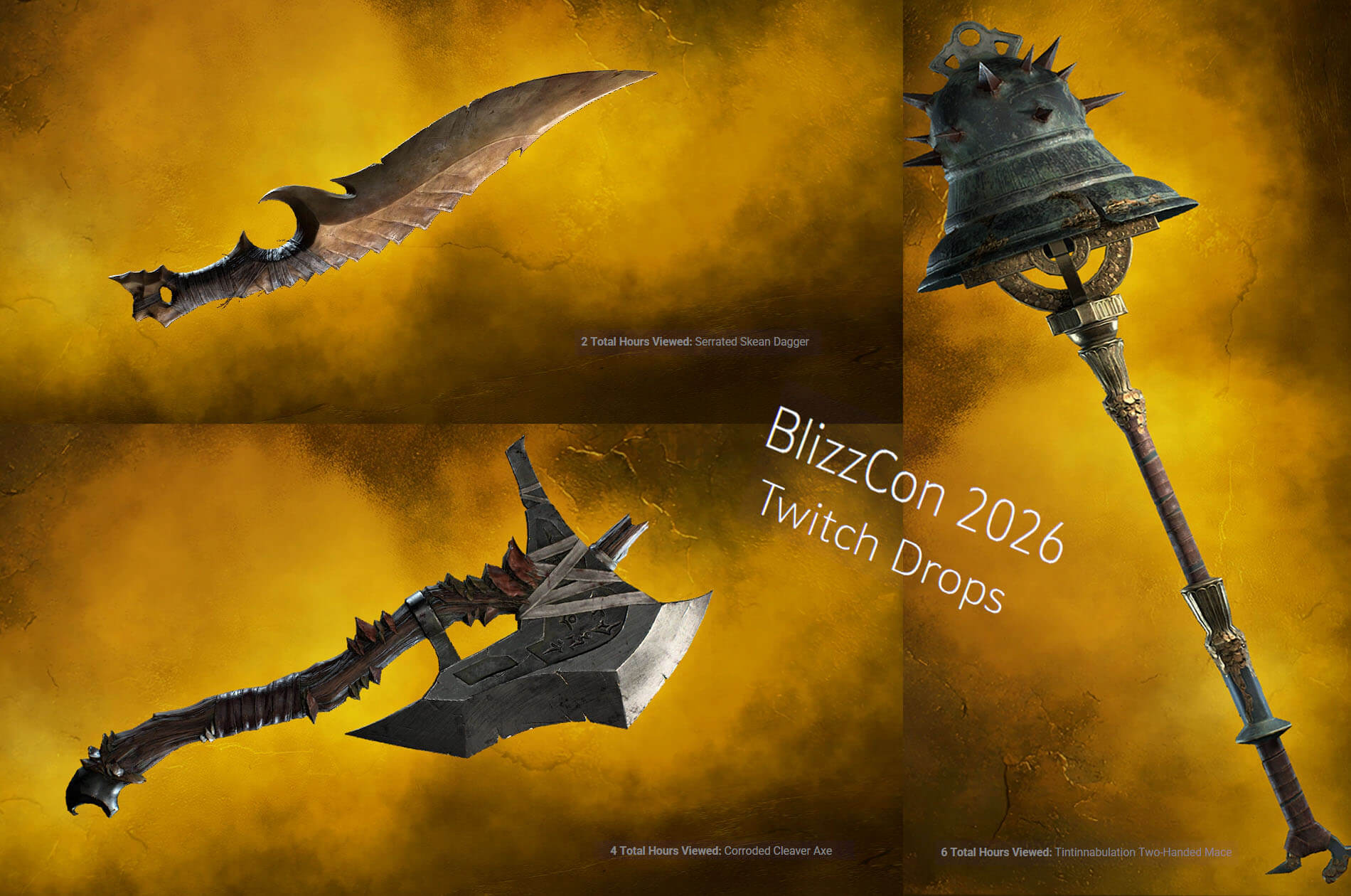 Twitch Chat Badges are visual indicators that appear next to a user's name in a stream's chat. They serve as a form of digital identity, offering viewers a way to distinguish themselves and showcase their support or participation within a specific community. While many badges are permanent and denote roles like moderators or subscribers, the focus here is on event-based badges, which are temporary and awarded for specific achievements or participation during limited time events. These event badges are designed to add an element of exclusivity and encourage active engagement within a set timeframe.
Earning an event badge typically involves fulfilling certain criteria announced by the streamer or Twitch itself. This might include watching a certain amount of a broadcast, participating in chat activities, or completing specific in stream objectives. Once earned, applying a custom Twitch badge is straightforward. Viewers can access their "Chat Identity" settings, usually by clicking an icon next to the message input box. From this menu, they can select their preferred badge to display. This allows for personalization and the ability to showcase earned event badges across different channels, either as a global identifier or as a channel specific custom badge, thus allowing viewers to prominently display their achievements. This system not only gamifies the viewing experience but also provides a tangible reward for active participation, strengthening the bond between the streamer and their dedicated followers.
Twitch Chat Badges are visual indicators that appear next to a user's name in a stream's chat. They serve as a form of digital identity, offering viewers a way to distinguish themselves and showcase their support or participation within a specific community. While many badges are permanent and denote roles like moderators or subscribers, the focus here is on event-based badges, which are temporary and awarded for specific achievements or participation during limited time events. These event badges are designed to add an element of exclusivity and encourage active engagement within a set timeframe.
Earning an event badge typically involves fulfilling certain criteria announced by the streamer or Twitch itself. This might include watching a certain amount of a broadcast, participating in chat activities, or completing specific in stream objectives. Once earned, applying a custom Twitch badge is straightforward. Viewers can access their "Chat Identity" settings, usually by clicking an icon next to the message input box. From this menu, they can select their preferred badge to display. This allows for personalization and the ability to showcase earned event badges across different channels, either as a global identifier or as a channel specific custom badge, thus allowing viewers to prominently display their achievements. This system not only gamifies the viewing experience but also provides a tangible reward for active participation, strengthening the bond between the streamer and their dedicated followers.
The Mechanics of Twitch Drops
Twitch Drops represent a more integrated and often more substantial form of reward, particularly prevalent in the gaming community. These are in game items, currency, or other virtual goods that can be earned by watching specific live streams. The process typically involves linking a Twitch account to a game developer's platform account, such as Battle.net for Blizzard games. Once linked, viewers who watch designated streams for a specified duration can earn rewards that are then automatically delivered to their linked game account. A common misconception regarding Twitch Drops is the requirement to own the game in question to earn the rewards. However, as indicated by the Diablo IV and Lord of Hatred example, owning the game is usually not a prerequisite for earning the drops. This inclusive approach allows a wider audience to participate and engage with the content, potentially fostering interest in the game itself. The process of linking accounts is also designed for simplicity. Users typically sign into their respective gaming platform accounts, navigate to a connection or linking section, and authorize the connection with their Twitch account, a process that often involves a straightforward sign in and confirmation. This seamless integration ensures that the focus remains on the viewing experience and the anticipation of earning rewards, rather than on cumbersome technical hurdles.Synergy Between Badges and Drops
While Chat Badges and Twitch Drops operate on different principles, they both contribute to a more rewarding and engaging Twitch experience. Chat badges provide immediate, visible recognition within the chat interface, fostering a sense of belonging and status among viewers. They are about community identity and participation. Twitch Drops, on the other hand, offer tangible, external rewards that enhance the experience of associated games or platforms, directly incentivizing viewership. Together, these features create a multi layered reward system. A viewer might earn an event badge for actively participating in a stream's chat during a special promotion, while simultaneously accumulating progress towards earning exclusive in game items via Twitch Drops. This dual reward pathway encourages sustained engagement, making viewers more likely to remain active participants for longer periods. The gamification inherent in both systems transforms passive viewership into an interactive and rewarding endeavour. Streamers benefit from increased viewer retention and a more active, invested community, while viewers gain recognition, exclusive items, and a heightened sense of connection to their favourite content creators and the games they play.Earning and Claiming Drops
A fundamental question for many interested in Twitch Drops revolves around the devices necessary for participation. The good news is that the system is designed for accessibility. Viewers can earn and claim drops using a personal computer or Mac via a web browser, or by utilizing the Twitch mobile application on either Android or iOS devices. This broad compatibility ensures that most viewers can engage with the system regardless of their preferred platform. However, it is important to note that Twitch applications on gaming consoles, smart televisions, and other TV apps do not support the functionality required to earn or claim these rewards. This limitation means that while a TV might be a primary gaming device, the act of earning drops must occur through more conventional computing or mobile devices. Another common point of confusion concerns the duration of viewership required to earn progress towards a drop. The system is designed with flexibility in mind, and viewers are not tethered to a single channel to accumulate watch time. Progress towards earning a drop can be made by watching any eligible channel within a specific game's category on Twitch. For instance, a viewer could watch half an hour on one channel and then switch to another eligible channel without losing their accumulated progress. This encourages exploration of different streamers and communities while still working towards the same in-game reward. However, it is vital to understand that this progress is not additive by watching multiple channels simultaneously. Watching more than one stream at a time will not accelerate the earning process. Furthermore, Twitch systems are designed to prevent passive accumulation; streams played in the background or in inactive tabs will not count towards the required viewing hours. Active engagement with the stream is therefore a prerequisite. The process of receiving rewards is another area that often causes confusion. It is crucial to understand that Twitch Drop rewards are not automatically deposited into a player’s in-game inventory. Instead, viewers must actively claim their earned rewards. This claiming process can be done directly on the channel where the progress was made, or through the dedicated Drops Inventory menu available within Twitch itself. This manual claiming step ensures that players are aware of their accomplishments and have control over when they accept their rewards.Reward Management and Streamer Involvement
Once a reward has been earned and claimed, a question about its longevity arises. Twitch Drop rewards do have an expiration period. Earned rewards will remain available for a period of seven days after they have been claimed, provided that a corresponding Battle.net account has been linked. This timeframe encourages timely linking of accounts and claiming of rewards, preventing a backlog of unclaimed items. Failure to link a Battle.net account within this seven-day window after claiming may result in the forfeiture of the reward. For streamers, the prospect of offering Twitch Drops on their channel can be an attractive proposition for increasing viewership and engagement. The requirements for streamers to participate are relatively straightforward. The primary prerequisite is ensuring that their Twitch account is successfully linked to their Battle.net account. Additionally, streamers must explicitly opt into the Drops program. By meeting these conditions, streamers can activate the Drops system for their channel, allowing their viewers to earn rewards by tuning in. This symbiotic relationship benefits both parties: viewers gain exclusive in-game content, and streamers benefit from increased audience attention and loyalty. Sign into your Battle.net account here For more information, see the How to Use Badges Twitch FAQ.Tournament Structure Enhancements
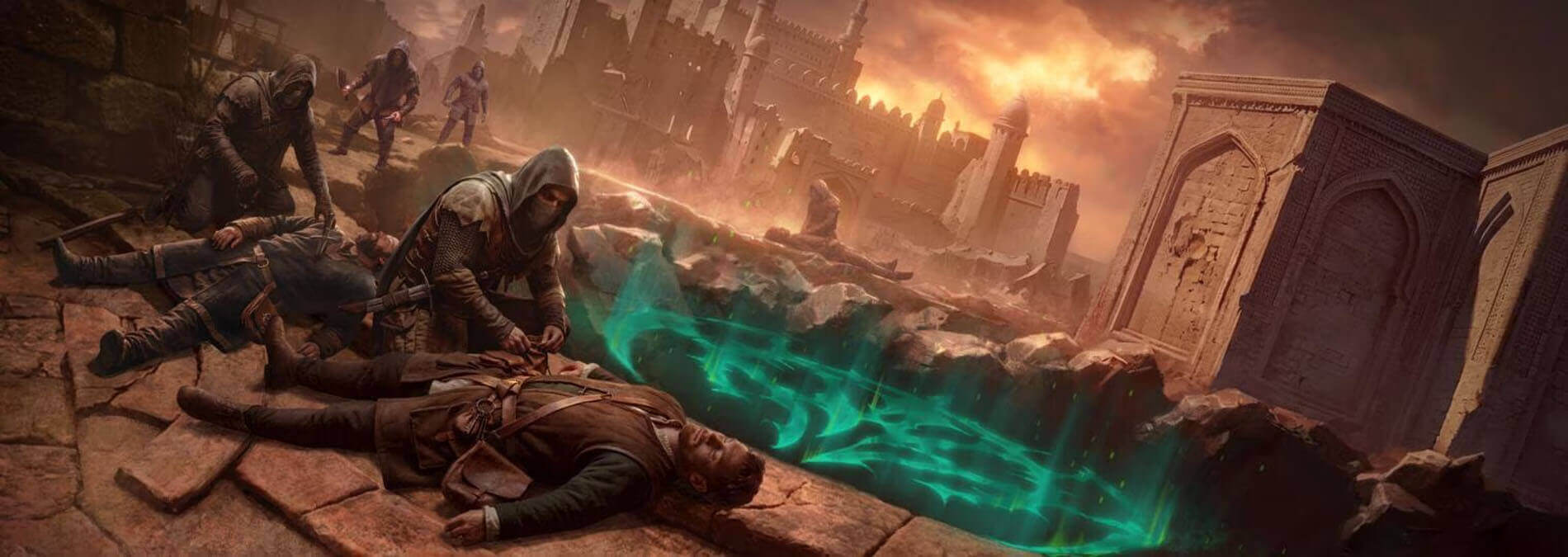 With the much-awaited comeback of the Cross-Server Bout of Realms, Diablo Immortal, the well-known action role-playing game, is ready to spark the flames of rivalry once more. The event is planned to coincide with the end of Blizz Con 2026, which promises an exciting time for gamers as open registration began on August 27, 2026, and finishes with the crowning of champions on September 13, 2026. This great event is more than simply a one-time competition; it comes with a series of cherished returning activities, offers new cosmetic items, a new Legendary Gem, vital class balance tweaks, and other major game changes. Particularly the Tower Wars map, the Cross-Server Bout of Realms is undergoing structural changes to improve the competitive environment by lowering needless matches, raising the overall player experience, and more clearly acknowledging the accomplishments of successful teams.
The returning Cross-Server Bout of Realms
This event brings notable changes to its tournament structure and prizes. The main goal of these changes is to make the competitive environment more efficient and rewarding. Reducing needless matches is one of the main goals; this guarantees that teams concentrate their time on meaningful interactions. This modification should increase the tournament's speed and intensity, therefore enhancing the impact of every level. Additionally, the improved system seeks to more effectively acknowledge and commemorate teams for their commitment and performance, providing more concrete rewards and appreciation for their involvement and results. The Open Registration time, from August 27 to August 30, 2026, is a great chance for interested players and their clans to sign up, so making sure that only committed and ready teams enter the fight. Establishing the competitive pool and enabling any needed last-minute changes to lineups or tactics depend critically on this first phase.Preliminary Stage Overhaul
The Preliminary Stage starts on August 31 and finishes on September 4, 2026, after registration. This phase is a key testing ground where teams battle one another to show their strength and earn a berth in the more sophisticated rounds. Acting as a gatekeeper to the higher echelons of the competition, the outcome in this stage directly determines a team's progress. The stakes are significant since the results here influence the whole competition and pinpoint which teams really have the potential to compete for the ultimate championship. The Preliminary Stage is undergoing a major change, splitting into two separate phases. This overhaul aims to reduce the total number of games played while simultaneously guaranteeing that the competition retains significance for all participating teams, even those not aimed for the grand finals. The Preliminary Stage's current competition structure was arranged in three phases. Over four days, with 12 rounds on the Tower Wars map, Phase 1 included a point-based competition employing a Swiss-system pairing with tiebreaks. The second phase, a playoff round, chose 64 players who had the same score. Over two days and six rounds, they played using the Swiss-system pairing with tiebreakers. The third phase was the knockout competition, a best-of-three or best-of-five, one-on-one elimination round spanning five days with twenty rounds. Teams amassing three losses in the first two days of the Preliminary Stage were eliminated under the previous structure, yet they still played out the balance of the preliminary stage. The new competition structure seeks to fix this by implementing a more dynamic elimination procedure. Though players with three losses at settlement will be removed right away, cutting down their tournament length, Phase 1, now known as "Stage 1 of the points race," will still make use of Swiss-System Pairing with Tiebreak on the Tower Wars map. This phase, which will last two days and consist of six rounds, Teams will inherit points from the first round in Phase 2, "Second stage of the points race," and continue with Swiss-system pairing and tiebreaks on Tower Wars for three days and nine rounds. The last phase, Phase 3, remains the Knockout Stage, a BO3/BO5 one-on-one elimination on Tower Wars spanning 5 days with 20 rounds. This amended format lowers the total match count while maintaining the entire competitive calendar for teams that progress by allowing poorer-performing teams to finish their tournament run earlier.Additional Progression Rewards
A new incentive milestone is being added for teams showing great performance for those moving on to the second stage of the Preliminary stage. Achieving this milestone will earn teams a Set item of the player's choice with a quality of 3+2 or above. This addition offers an additional level of motivation and real rewards for teams making substantial advancement even if they do not finally reach the Finals Stage. This guarantees that more teams believe their efforts are valued and acknowledged all during the tournament.Custom Champion Announcement
The competition then ramps up to the Finals, set to happen from September 7 to September 11, 2026. This is the meeting place of the Bout of Realms' elite. Pressure builds as teams fight for dominance, highlighting the height of Diablo Immortal's player-against-player warfare. The finals are usually distinguished by intense strategic preparation, perfect execution, and the capacity for adaptation under great stress. Teams that have made it this far have already shown their worth, and the finals are the ultimate test of their ability, teamwork, and stamina. The debut of custom champion announcements is a fresh and celebratory feature of the Cross-Server Bout of Realms' comeback. The victorious squad will now have the rare chance to send a customised, server-wide announcement to mark their championship win. This message will be sent throughout the server after an evaluation and approval process, therefore letting the victorious team to declare their hard-won glory to all players. This feature gives the winners a lot of server-wide recognition and customized bragging rights. The Third-Place match on September 12, 2026, and the Championship match on September 13, 2026 comprise this last section into two major events. Although not the ultimate reward, the Third-Place game is an essential game for teams trying to maintain a respectable standing and get credit for their work over the event. As teams compete for the distinction of being among the best rivals, it typically offers an interesting show of high-level play. The Championship game, where the two strongest teams battle for the title of Bout of Realms champions, is the highlight of the event. This game is more than simply a game; it is the outcome of weeks of planning, tactical thinking, and many fights. The winners are not only praised for their exceptional ability and teamwork but also receive substantial bragging rights and in-game awards that symbolize their top-tier standing inside the Diablo Immortal world. This architecture guarantees a definite and unambiguous finish, removing any question as to who rules across the linked worlds. With its phased strategy and cross-server integration, the Bout of Realms offers a strong framework for competitive interaction, motivating players to aim for greatness and engage in a major, server-spanning tournament.Seeker's United: A Celebration of Past and Present Challenges
The Seeker's United event, running from August 26 to September 23, 2026, presents a meta-event designed to bring back and highlight various existing event types. This approach leverages established gameplay loops, making it accessible for both new and returning players, while offering veteran players opportunities to earn progress and rewards for activities they may already be familiar with. The event's structure, which cycles through distinct challenges like Survivor's Bane, Trial of the Hordes, Fractured Plane, and Wild Brawl, ensures a varied experience over its duration. This variety prevents monotony and caters to different player preferences, whether they enjoy survival challenges, horde-mode combat, or competitive PvP. The emphasis on weekend PvP during Seeker's United suggests a deliberate strategy to concentrate player activity during peak engagement times, fostering a more dynamic and competitive atmosphere for these specific modes. The core mechanic of "earning progress and rewards" implies a tiered system where consistent participation across the different sub-events leads to cumulative benefits, encouraging players to log in regularly throughout the month-long event. This is a common and effective strategy in live-service games, rewarding dedication and time investment.Winds of Fortune: Amplifying Specific Reward Avenues
In contrast to the broad scope of Seeker's United, Winds of Fortune, occurring from September 3 to September 10, 2026, focuses on amplifying specific reward streams, particularly those related to Normal Gems and tradable items. The doubling of the 4-player party Normal Gem bonus drops, even when unaffected by the daily cap, represents a significant incentive for cooperative play and targeted farming. Normal Gems are a critical resource for character progression, directly impacting a player's power level. By temporarily removing or significantly increasing daily caps, the event encourages players to group up and dedicate more time to activities that yield these valuable gems. The limitation that only the first twelve Common Gems of the day are tradable, however, introduces a strategic layer. It encourages players to prioritize which gems they wish to sell for profit and which they might use directly for their own character's enhancement. The activation of a 24-hour buff provides a personal boost, but the real-time duration and automatic activation if not manually initiated suggest a design that aims to maximize player benefit regardless of their active login status at specific moments. This ensures that even players with less consistent login schedules can still benefit from the event's bonuses.Reward Duplication and Limitations
Both Seeker's United and Winds of Fortune incorporate mechanics related to duplicate item drops, such as Gold, Experience, Battle Pass Points, Normal Gems, and Legendary Items. The explicit mention that these items "will drop in duplicate quantities" signifies a direct increase in the rate at which players acquire these resources. This is a powerful draw, as it accelerates progress and enhances the feeling of reward for time spent in the game. However, the crucial caveat is that these duplicate drops are subject to limits, where players earn double until they reach a predefined cap. This is a standard game design practice to prevent hyperinflation of resources and to ensure long-term game economy stability. Without such limits, a prolonged event with unlimited duplicate drops could render future content less rewarding or lead to an unsustainable economy within the game. The inclusion of specific activities like Dungeons, Bounties, and wilderness farming as sources of these doubled drops indicates that the developers aim to boost rewards across a wide spectrum of gameplay, encouraging participation in various facets of Diablo Immortal. The exclusion of Battle Pass rewards from doubling and the unchanged weekly limits on Battle Pass Points and Normal Gems highlight a targeted approach; the developers are focusing the event's boosts on core progression and economy rather than the Battle Pass system itself, which often has its own distinct progression and reward structure.The Seething Polestar Gem: A New Offensive Force
The introduction of the Seething Polestar as a two-star Gem, accessible through the Empowered Battle Pass starting with Season 56, signifies a strategic addition to players' arsenals. At its Rank 10 description, the gem’s power lies in its area of effect (AoE) damage and its chaining potential. When an enemy is struck, beams of Seething Light descend upon their location, inflicting damage on them and any nearby foes. Crucially, the gem introduces a dynamic chaining mechanic: enemies hit by Seething Light have a chance to trigger subsequent beams, creating a cascading effect. This chaining is amplified by the number of enemies hit, with each successful chain increasing the likelihood of further connections. However, this cascading power comes with inherent limitations designed to maintain game balance. Each subsequent blast experiences a 30% reduction in both radius and damage, preventing an unchecked exponential growth of damage output. Furthermore, the Seething Light effect also bestows a dual benefit upon the player: it increases their damage dealt to targeted enemies and simultaneously reduces their movement speed for a brief two second window. These beams, however, have a cooldown, being able to be called down no more frequently than once every six seconds, and the chaining is capped at a maximum of three additional blasts. This combination of potent AoE, conditional chaining, and player buffs, balanced by damage and radius reduction and a cooldown, makes the Seething Polestar a compelling choice for players seeking to enhance their offensive capabilities, particularly in crowded combat scenarios. Its inclusion as a Battle Pass reward ensures a degree of accessibility while still rewarding dedicated engagement. The resonance gems Havoc Bearer, Specter Glass, and Rampant Torch are also mentioned as related items, hinting at potential synergies or further avenues of progression within the gem system.Jewel of the Desert: Lut Gholein's Aesthetic Embrace
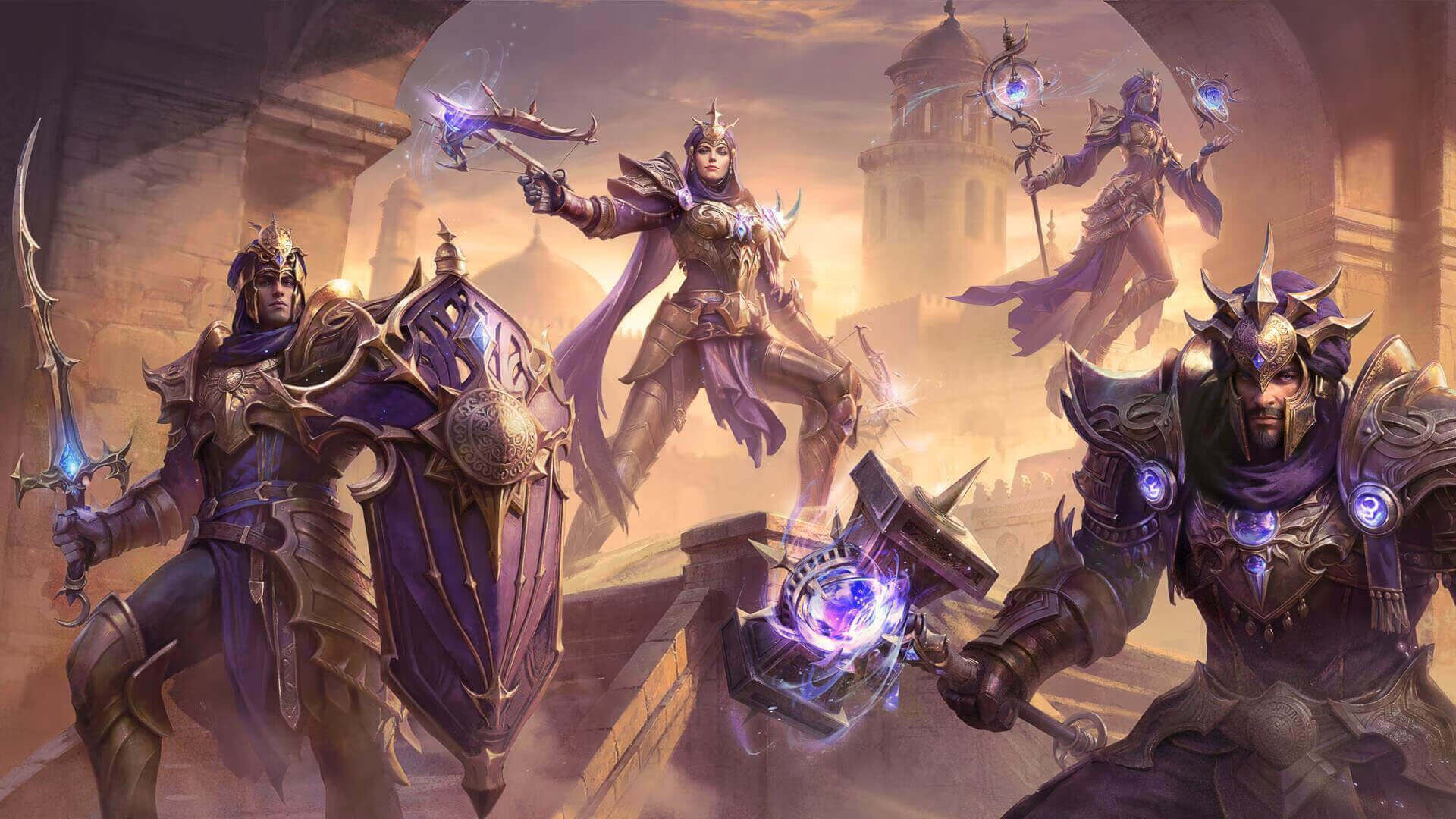 Complementing the gameplay enhancements, the Jewel of the Desert cosmetics event offers a thematic departure, drawing inspiration from the sun drenched, opulent city of Lut Gholein. Scheduled to run from August 27, 2026, to September 24, 2026, this event provides players with exclusive cosmetic armour and weapon sets that encapsulate the essence of this fabled desert metropolis. The design motifs are explicitly stated to echo the sun, the city's glorious golden spires, and the aesthetic splendour of its High Ward. Such thematic events are a cornerstone of Diablo Immortal's ongoing content strategy, offering players opportunities to personalize their characters beyond mere statistical optimization.
The visual appeal of these cosmetics allows players to embody the spirit of Lut Gholein, transforming their avatars into representations of the city's grandeur. This focus on aesthetics caters to a significant portion of the player base that values visual customization and role playing. The integration of specific architectural and symbolic elements like golden spires and sun motifs provides a cohesive and immersive experience, reinforcing the game world’s lore and expanding its visual palette. By offering these exclusive items through a limited time event, developers encourage player participation and create a sense of urgency, fostering a more active community during the event period.
Complementing the gameplay enhancements, the Jewel of the Desert cosmetics event offers a thematic departure, drawing inspiration from the sun drenched, opulent city of Lut Gholein. Scheduled to run from August 27, 2026, to September 24, 2026, this event provides players with exclusive cosmetic armour and weapon sets that encapsulate the essence of this fabled desert metropolis. The design motifs are explicitly stated to echo the sun, the city's glorious golden spires, and the aesthetic splendour of its High Ward. Such thematic events are a cornerstone of Diablo Immortal's ongoing content strategy, offering players opportunities to personalize their characters beyond mere statistical optimization.
The visual appeal of these cosmetics allows players to embody the spirit of Lut Gholein, transforming their avatars into representations of the city's grandeur. This focus on aesthetics caters to a significant portion of the player base that values visual customization and role playing. The integration of specific architectural and symbolic elements like golden spires and sun motifs provides a cohesive and immersive experience, reinforcing the game world’s lore and expanding its visual palette. By offering these exclusive items through a limited time event, developers encourage player participation and create a sense of urgency, fostering a more active community during the event period.
Game Updates
Empowered Battle Pass Enhancements
The introduction of the Empowered Battle Pass and its Collector's counterpart has brought tangible benefits to players willing to invest further. A notable change is the replacement of the War Herald with the Seething Polestar, a new two-star gem, as a selectable reward. This offers a more desirable early game progression tool. Furthermore, upon reaching level 35, the normal gem reward is now expanded to offer a choice of three new options, allowing players to tailor their milestone rewards more precisely to their current needs and preferred playstyle. These updates to the Battle Pass system encourage deeper engagement by providing more meaningful and customizable rewards, fostering a sense of continuous advancement and strategic decision-making.Dungeon and Rift System Adjustments
To alleviate common frustrations within Diablo Immortal's cooperative content, several key adjustments have been made to Dungeons and Elder Rifts. The most impactful change is the immediate resurrection of dead players upon clearing a challenge dungeon. This eliminates the tedious downtime and potential for failed runs due to a single unfortunate death, making group content more fluid and less punishing. Additionally, the initial challenge of the Elder Rift, which previously yielded three runes, now rewards nine Telluric Fragments. This streamlines the early game progression for new players, ensuring they receive a more substantial and useful currency to kickstart their gearing process without unnecessary steps. These revisions promote a more forgiving and efficient cooperative experience.Quality of Life Improvements for Monster Essence
A significant quality of life improvement has been implemented concerning the Monster Essence turn-in process. Previously, using the Monster Essence notification would teleport players to the nearest safe zone but would not create a return portal to their farming location. This was inconvenient for players who needed to gather more essences, forcing them to manually travel back. The updated system now opens a portal to the nearest safe zone, which functions independently of the regular Town Portal cooldown and is not interrupted by damage. This ensures players can quickly return to their current farming spot without significant interruption, making the collection of Monster Essences a much smoother and less disruptive activity.Helliquary Enrage Mechanics Rebalanced
The Helliquary Enrage mechanic has undergone a crucial rebalancing to ensure class parity and prevent exploitative gameplay. Previously, certain class builds could effectively negate the Enrage mechanic by having excessive survivability, trivializing boss encounters. The developers have shifted away from nerfing specific builds and instead modified the Enrage mechanic itself. Now, the passive damage dealt during Enrage scales over time, reaching 100% of a player's maximum Life after 45 seconds, and this damage cannot be mitigated by shields, damage reduction, immunities, or cheat death effects. This change ensures that all players experience the intended challenge of the Enrage mechanic without allowing for absolute immunity, promoting a more equitable and engaging boss fight experience, particularly in challenging content like the Helliquary Gauntlet.Legendary Gem Attribute Clarity
A significant backend upgrade has been made to how Legendary Gem attributes are displayed, aiming to provide greater clarity for players. Previously, complex stats were often aggregated into single display values, requiring players to perform calculations to understand the true impact of a gem's passive bonus. The updated system allows for more direct display of attribute values. For instance, instead of a vague percentage tied to another stat, it will now clearly state the direct percentage increase. This enhanced clarity in the Legendary Gem Upgrade UI will help players better understand the strengths of their gems and make more informed decisions regarding gem upgrades and builds, especially as new and more complex gems are introduced.Monthly Card Optimization
One of the most impactful recent updates revolves around the optimization of the Monthly Card, specifically the "Boon of Plenty." The core objective of this change is to significantly increase the perceived value of this in-game purchase without altering its price point. This is a crucial strategy for retaining players and encouraging ongoing investment. The update achieves this by strategically replacing less desirable rewards, such as normal gems and crests, with Telluric Pearls. Telluric Pearls are highly valued by players for their utility in acquiring powerful items and advancing their characters, making this swap a direct upgrade to the card's appeal. Furthermore, the developers have increased the number of Special Reward (SR) Gems available through the Boon of Plenty. Crucially, they have also expanded the selection pool of SR gems to include the War Herald. This addition provides players with access to a more diverse range of potent gems, further enhancing the statistical growth and combat capabilities of their characters. These adjustments indicate a thoughtful approach to in-game economy management and player satisfaction, ensuring that recurring purchases offer tangible and desirable benefits.UI and UX Updates
Beyond monetary incentives, a significant portion of the recent updates focuses on improving the player's interaction with the game world through UI and UX enhancements. The Activity Tab has undergone a redesign, incorporating a sub-tab feature. This addition is a practical solution to the common problem of cluttered in-game event menus. By categorizing and organizing current events more clearly, players can more easily navigate and discover available activities, reducing confusion and increasing engagement with time-sensitive content. The Phantom Gallery has also seen improvements. The visual direction has been unified by updating the Gem icon to match the latest aesthetic standards. More importantly, the related Gem VFX has been enhanced. These visual flair upgrades are not merely cosmetic; they are designed to improve visual clarity, making it easier for players to understand the impact of their rewards and the significance of gem acquisitions. In Westmarch, the game's central hub, art optimization has been implemented. This includes adding more texture fidelity to environments and terrain, enhancing atmospheric lighting, and improving visual effects such as water, smoke, and vegetation. Adjustments to existing props and structures further contribute to a more immersive and visually appealing world. These environmental upgrades create a richer, more believable game setting, enhancing the overall aesthetic appeal and player immersion.Interface and Bug Fixes
The practicalities of gameplay are also addressed through UI optimizations and a comprehensive list of bug fixes. Several UI issues that could hinder gameplay within dungeons have been resolved. The problem of NPC dialogue obscuring the skill bar UI and other interface operations has been optimized, ensuring that players have unobstructed access to their abilities and crucial game information. Additionally, the issue where skill buttons were obscured by a black overlay during channelling has been fixed. This optimization is vital for players to clearly see the cooldown status of their abilities, allowing for better strategic decision-making in combat. The interface displayed when a player's Seeker Rating reaches its maximum value has also been refined. Beyond UI, a significant number of miscellaneous bugs have been fixed, demonstrating a commitment to game stability and fairness. These include issues with the Tide Pool from the Tempest Legendary Essence not triggering Electrocution, the Warlock skill Burning Ascent not removing Slow effects, and abnormal damage reduction from the Warlock Legendary Essence Measured Halves. Furthermore, a bug affecting Druid human form abilities where they could not increase Claw attack numbers from the WulftearClass Balance Changes in Diablo Immortal
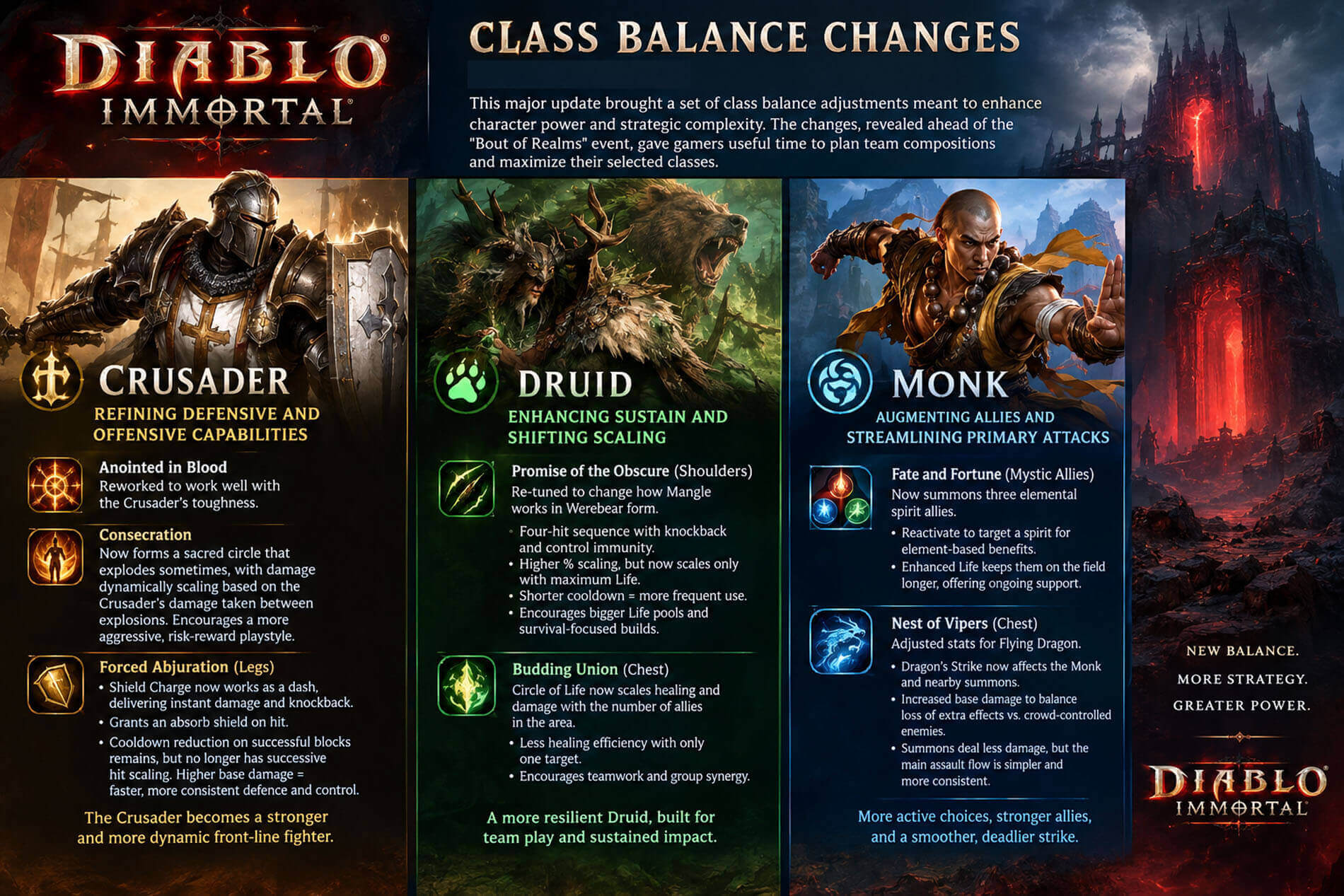 This major update on August 26, 2026, brought a set of class balance adjustments meant to enhance character power and strategic complexity. These changes, revealed ahead of the "Bout of Realms" event, gave gamers useful time to plan team compositions and maximize their selected classes.
Crusader: Refining Defensive and Offensive Capabilities
Notable changes to the Crusader class concentrated on improving both defensive utility and offensive output. The legendary helmet item "Anointed in Blood" was reconceived to work well with the Crusader's toughness. "Consecration" used to deal damage depending on a fixed amount. The updated version forms a sacred circle that explodes sometimes, with its damage dynamically scaling depending on the Crusader's damage taken between explosions. This promotes a more aggressive playing style, which benefits players that can absorb damage while keeping offensive pressure. This change makes the skill an active, risk-reward tool rather than a passive source of damage. Moreover, the "Forced Abjuration" legs legendary item underwent a major rework, altering its fundamental operation. The first version of "Shield Charge" concentrated on a frontal cone assault with a damage-increasing effect on successive hits and a cooldown reduction tied to successful blocks. The refurbished "Shield Charge" works as a dash, delivering instant damage and knockback upon contact. More crucially, upon striking an adversary, it provides an absorb shield that enhances the Crusader's ability to survive in close combat. Although the cooldown reduction for successful blocks remains, the elimination of successive hit scaling and the rise in base damage indicate a more consistent and quicker surge of defence and control. Together, these enhancements seek to turn the Crusader into a stronger and more dynamic front-line fighter.Druid: Enhancing Sustain and Shifting Scaling
The Druid class underwent changes meant to enhance its sustained healing and change the damage scaling for important skills. The "Promise of the Obscure" shoulders legendary item, which changes how the "Mangle" skill works in Werebear form, was re-tuned. The upgraded "Mangle" now unleashes a sequence of four assaults with built-in knockback immunity and loss of control protection. Although the percentage scaling has been enhanced, the damage now scales only with the Druid's maximum Life. This tweak motivates bigger Life pools for Druids, possibly diverting build priorities toward survival while guaranteeing steady, though Life dependent, damage output throughout the violent Werebear transformation. The shorter cooldown lets one use this great power more often. The "Budding Union" chest legendary item also underwent changes related to its "Circle of Life" skill. This ability produces an area of effect that heals allies and harms adversaries. The updated version now sees its healing and damage increase with the number of allies within the area. But the healing efficiency has gone down when there is only one target in the zone. This change encourages Druids to play nearer to their teammates, therefore enhancing their role as a support class that depends on group synergy. The aim is to discourage solo healing situations from being as effective and reward coordinated play.Monk: Augmenting Allies and Streamlining Primary Attacks
Changes to the Monk class were made to improve the efficiency of their summoned companions and to hone the synergy of their main strike. The "Fate and Fortune" main-hand legendary item for "Mystic Allies" was changed to summon three elemental spirit allies. A new mechanic lets players reactivate the ability to aim at one of these spirits, giving the Monk beneficial effects depending on the spirit's element. This adds a layer of active interaction and strategic choice to the summoning process, enabling on-demand boosts. The enhanced Life for Mystic Allies also guarantees they stay on the field longer, offering ongoing support. The chest legendary item "Nest of Vipers", which modifies the skill "Flying Dragon", had its stats adjusted as well. The earlier version gave "Dragon's Strike" following the employment of the skill, therefore unleashing energy waves upon Primary Attacks. The new version gives the Monk as well as surrounding summons "Dragon's Strike". The basic damage of "Dragon's Strike" was raised to balance the loss of extra effects brought on by striking crowd-controlled opponents. Still, summons deal less damage with their "Dragon's Strike" attacks. This seeks to simplify the Monk's main assault flow and deliver more consistent damage output, all while positioning the player character as the primary recipient of the improved effect, with summons providing supplemental albeit weaker input.Specific Adjustments for Tempest and Warlock
Two of the core skills of the Tempest class underwent significant changes. The legendary item "Tempest Dream and Drown" in the Helm slot had its "Cascade" skill changed. Cascade used to give Zephyrs' strikes the ability to unleash waves damaging both close and distant foes. This basic capability is kept in the new version, but it's important to note that an absorb shield is added when a wave strikes an opponent. This enhancement provides the Tempest the survival boost it needs, enabling them to fight more aggressively or endure damage over extended fights. Along with this change, a maximum range trigger was added for Cascade to stop its waves from hitting enemies too far away, which makes the skill's use more controlled and strategic. Moreover, the Off-Hand item "Cyclone's Call" had its "Crosswinds" ability re-engineered. Originally a channelled ability activated while moving, it propelled wind blades. The revised edition keeps the channelling and movement components but adds immunity to knockbacks while channelling, a rather defensive enhancement. Furthermore, swiftly hitting an adversary with numerous wind blades now causes an extra strike, raising the skill's damage potential. Developers lowered the energy consumption while channelling and raised energy regeneration, therefore enabling longer channelling periods and quicker energy recovery.
Particularly influencing the "Measured Halves" trousers and the "Supply and Demand" trousers, the Warlock class also underwent significant changes. The "Spiteful Sacrifice" ability on Measured Halves now channels swords of dark energy and can be cast while moving. Though the attack interval has grown, the damage per strike has been greatly enhanced, leading in fewer but stronger volleys. To counteract this, channelling slows down movement speed, and the range has been lowered. The "Sacrificial Power" effect no longer locks onto players, but instead fires additional projectiles at the target's current position, hence increasing their vulnerability to evasion. The "Tyrant's Grasp" skill now gives the "Supply and Demand" pants an absorb shield by taking the Soulgorger as an offering of power before conjuring demonic hands. While Tyrant's Grasp can no longer be active concurrently with the Soulgorger, its cooldown has been lowered for more frequent shield acquisition. The third attack no longer has a knockback effect; instead of dealing damage to foes at maximum range, it has more base damage. With the Warlock's "Brutal Lessons" shoulders, Primary Attacks are now augmented with molten chains that inflict damage, knock back, and ignite close-by opponents. Hitting the same enemy grants life drain and control immunity, with the cooldown reduced to align with the "Supply and Demand" cooldown.
Changes were made to the Wizard class's "Lissana's Sorrow" chest piece and "Searing Judgement" shoulders. The "Frostfield" ability now bestows "Creeping Chill", which causes attacks to chill enemies, and critical hits will freeze foes inside the range. The chill value has been raised to improve crowd control ability. The "Searing Judgement" shoulders change "Disintegrates" into a fire-based attack, adding a burn effect that can stack up to five times. At five stacks, the burn is depleted for more damage. Wizards are now immune to Knockback effects while channelling. The beam distance has been lowered, and the maximum stack count for the burn has been raised, therefore lowering the frequency of additional damage triggers but increasing the overall damage output to compensate.
Together, these changes hope to improve the combat meta in Diablo Immortal. The improved crowd control and damage potential of Crosswinds together with the higher survivability of The Tempest afforded by the absorb shield on Cascade help to qualify the class for more active front-line fighting. The Warlock's adjustments on Measured Halves lean towards a more deliberate, high-impact playstyle, demanding precise positioning given lowered range and movement speed but rewarding gamers with destructive strikes. By contrast, Supply and Demand provides a more reliable defensive layer with the absorb shield and somewhat modified offensive capabilities. The Wizard finds that Lissana's Sorrow improves their utility and control via stronger chilling and freezing capabilities, therefore making them powerful in governing opponent movement. Searing Judgement's changes to Disintegrate point to a move to sustained damage output with the potential for burst damage; the knockback immunity offers crucial self-preservation during channelling.
Early communication of these developments is a deliberate action by the developers to create a more balanced and interesting environment for competitive play, especially with the Bout of Realms event. Under the revised balance parameters, players are advised to try with fresh legendary item combinations, skill rotations, and team compositions to maximize the effectiveness of their selected class. For the survival of any online multiplayer game, this iterative process of refinement is absolutely essential since it guarantees that no one class or approach becomes too dominant, therefore fostering variety and strategic depth.