Blizzard Quote [source]
We've read through over 400 comments, emails, forum posts, and tweets submitted by players around the world, each providing a unique suggestion for what kind of Legendary power our upcoming Mephisto-themed sword should wield.
From this amazing, though massive pool of creativity, community managers from our regional offices pared down the list of suggestions to approximately 50, bearing in mind the design philosophies, goals, and limitations defined by Travis and John in our Design a Legendary livestream. From those suggestions, our designers have selected five possible Legendary powers for you to vote on, listed below!
Please note that these powers are not final and, if selected, would still be subject to a full tuning pass. For many of the powers, values like damage %, radius size (for area of effect abilities), and effect durations have not yet been implemented and would be determined after balance testing has taken place.
 Legendary Power #1:
You radiate an aura of Hatred. All monsters near you deal and receive additional damage.
Legendary Power #2:
Attacks have a chance on hit to cause your current target to be hated by all nearby enemies, taunting them to attack that target for the duration of the effect.
Legendary Power #3:
When you are near death, your hatred for your enemies grows, significantly reducing your resource costs and cooldowns.
Legendary Power #4:
Elemental attacks have a chance to trigger one of powerful abilities inspired by the Lord of Hatred himself: Charged Bolt, Poison Nova, and Freezing Skull. Lightning damage has a chance to trigger a Charged Bolt. Poison damage has a chance to trigger Poison Nova. Cold damage has a chance to trigger Freezing Skull.
Legendary Power #5:
Summons an Evil Force to fight alongside the player for a period of time. This force would take the form of a non-attackable melee pet, and it would be possible to potentially have more than one Evil Force active at once.
An item's power (or proc) is perhaps the most important part of any Legendary, and which power we choose for our Mephisto-themed, one-handed is now completely up to you. Pick your favorite by using the voting options below, and be sure to spread the word. As with previous votes, whichever theme gets the most votes globally wins!
After the poll has closed, we'll tabulate player votes from all our different Diablo III communities around the world to determine the winner and share the results next week. Don't delay, though—this poll will close Wednesday, January 22.
Blizzard Quote [source]
Over the last few weeks, we’ve launched a new callback-based system for players who need phone support. This is a big change from our traditional phone support, so we wanted to provide some details about this service.
How does the callback system work?
- Instead of calling a number (and potentially waiting on hold) for support, you’ll use the support site on Battle.net to request a callback.
- You’ll enter information about your issue, along with your phone number.
- A Game Master will give you a call back.
How does the callback system benefit me as a player?
- You won’t have to navigate a phone menu or spend time on hold.
- Since the support site collects critical details in advance (like the answer to your security question), you’ll jump directly into problem solving.
What’s happening to Blizzard Customer Support’s existing phone numbers?
- We’re transitioning to a point where our phone lines will no longer present a menu system, but instead play a brief message directing users to the support site.
We hope you enjoy using the new service to get help when you need it!
Blizzard Quote [source]
"Of late, my dreams as haunted by one thing: the Black Soulstone. I see the crystal reflected in all things, at all times. It has become my obsession, my purpose in life."
A few months ago we announced the upcoming Diablo III: Storm of Light, and today we're thrilled to offer you an exclusive preview of this epic new chapter of Sanctuary's continuing story, which is set to be released on February 4, 2014.
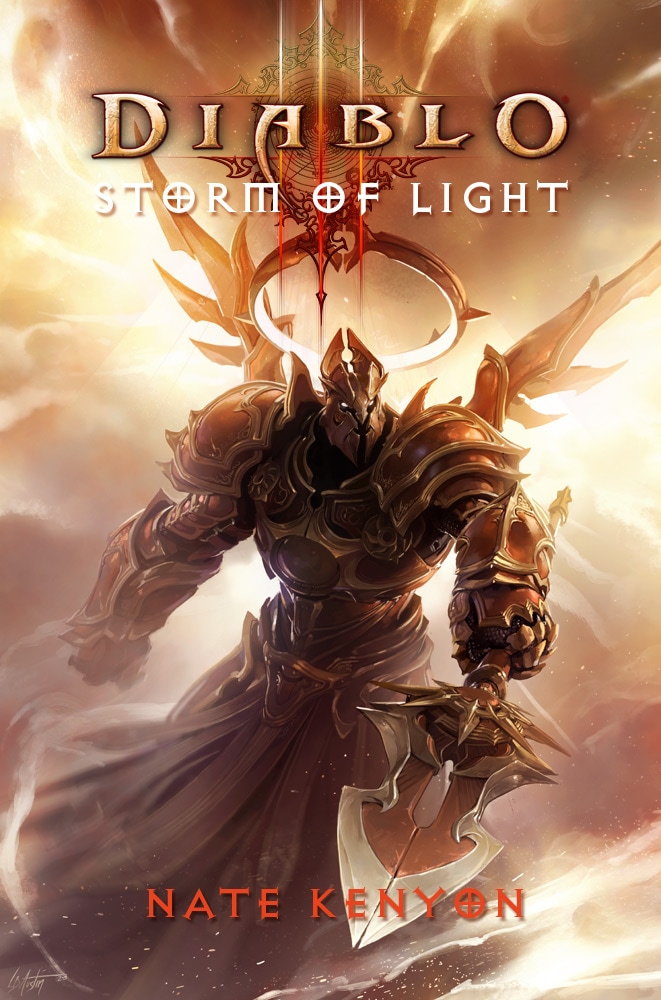
Written by Nate Kenyon, author of The Order, Storm of Light is a bridge between the events of Diablo III and the story that is to come in its first expansion, Reaper of Souls. This new novel is now available for pre-order at Simon and Schuster and features Jacob and Shanar from the Sword of Justice comic series, as well as other characters from the Diablo universe that players have previously met.
In Storm of Light, the Angiris Council has recovered Diablo's Black Soulstone and they now stand vigil over the cursed artifact deep within the glimmering Silver City, unwittingly condemning the High Heavens to its dark corruption. Imperius and the other archangels vehemently oppose moving or destroying the crystal, leading Tyrael to put Heaven's fate in the hands of mortals. Drawing powerful humans to his side from the far ends of Sanctuary, Tyrael reforges the ancient Horadrim and charges the order with an impossible task: to steal the soulstone from the heart of Heaven.Read on for an exclusive excerpt from Chapter 4 of Storm of Light!
"Then tell us what insights you have gained from Chalad'ar, Wisdom," Imperius said, his voice mocking once again. "Tell us what to do with the stone. The Council has been divided on this for too long. Or are the rumors among the angels correct, and you have yet to consult the chalice?"
Itherael and Auriel turned to Tyrael, waiting for him to offer a solution. He looked at the soulstone on its perch, imagined he saw a beat of blood-red light at its core. The darkness pervades this holy place, he thought. It creeps in unbidden and corrupts everything it touches.
Tyrael had come to his own decision. But he was unsure about how his advice would be taken by the others and hesitated for a moment too long.
Imperius turned away. "Malthael would have never been without an answer, yet this one is silent once again. I shall speak for him, then. We break the stone at the Hellforge."
A murmur from Auriel brought a fast response. "We should not risk destroying it," Itherael said. "It was forged by human magic; its destiny is a mystery to me. Even the Scroll of Fate cannot tell us what might result from such an attempt--"
"It must be hidden!" Tyrael said.
His words rang out, stronger than he might have intended. The others stopped, their attention returning to him. He cleared his throat again, hating how weak it made him sound. A throat made of flesh and blood was not a trustworthy vessel for such a speech. He tried again. "Itherael is right," he said. "The Black Soulstone's power is unknown to us. The Horadric mage Kulle forged it using magic the nephalem alone possess. We cannot risk trying to destroy a thing like this; it may even release the Prime Evil upon us once again."
"Hide it where?" Auriel's tone had grown cautious, as if she knew what he might say. "We have already discussed shrouding it but could not come to an agreement. It cannot stay in the Council chambers forever."
Tyrael looked at his fellow archangels, sadness washing over him. He imagined that they viewed him with suspicion, perhaps thinly veiled hostility. Even Auriel's aura had changed, her wings pulsing softly with a light that mirrored the taint he had seen in the gardens among the trees.
He was not Justice, nor Wisdom, nor was he a man; he was a mortal angel, and this did not fit with the world they knew, or with any other. His vision of peace with the land of men and a new life ending in eternal sleep was swiftly fading.
He had never meant for it to come to this.
"In Sanctuary," he said finally. "We must hide the stone in a place where neither angel nor demon can reach."
So prepare for the return of Tyrael and the new Horadrim, and make sure to pre-order your copy of Storm of Light at Simon and Schuster today so that you can be among the first to find out what happens to our heroes in their next great adventure!
Blizzard Quote [source]
It must be awesome to have an artist in the family, and Miguel, admin of official fansite Diablo3-esp.com since 2006, is lucky enough to have one at home. His mother’s hobby is to craft socarrats – a form of traditional medieval art consisting of fired clay tiles painted in red and black.
She was persuaded to craft a socarrat in the image of her son’s favorite archangel, Tyrael. Miguel has been a fan of Diablo since 2000, and even though his mom isn’t into videogames herself, she accepted the challenge quite happily.
Q. What does “socarrat” mean?
Socarrat is the Valencian word for “burned” or “scorched”. It comes from the way a socarrat is cooked, since the clay tile is actually burned where the image has been drawn.
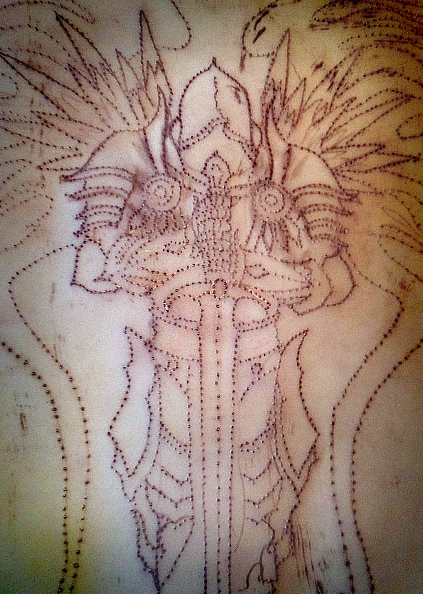
The first step is to perforate the paper and apply black dust to mark the silhouette of the sketch on the tile.
Q. What can you tell us about the history behind socarrat art?
Socarrats originated on the eastern coast of the Iberian Peninsula during the Middle Ages, mainly in Valencia. They were generally placed between the wooden beams of old houses, sometimes in stairways, or even on the exteriors of buildings for decoration. They usually depict religious, magic, and social figures.
Q. How are socarrats made?
The tile is covered in quicklime dust, over which the artist draws the picture using red and black tones before the tile is fired. This gives the socarrats a very distinct appearance.
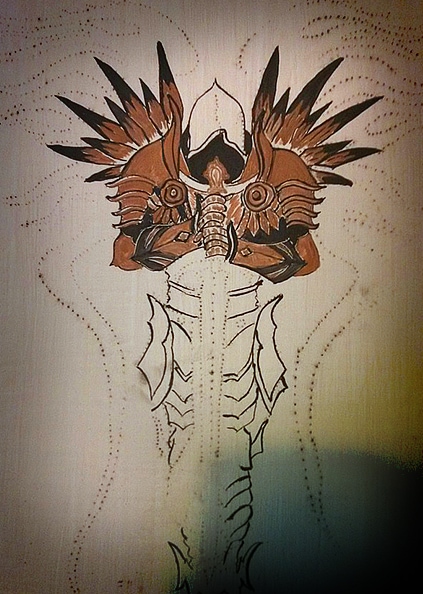
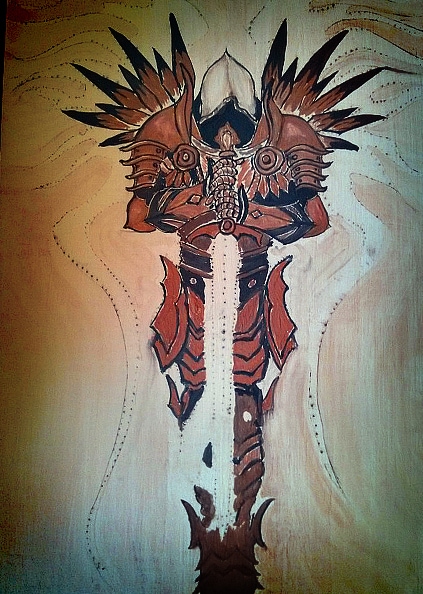
Here you can see part of the silhouette from the first step, and the beginnings of the red and black tones being applied.
Q: Where did your mother learn how to make them?
She has been making socarrats for years in the cultural center of our town in Spain. We have plenty of socarrats all over the walls of our house.
Q. What materials did you mother use for your Tyrael socarrat?
You just need a clay tile, the typical size of which is 30x15cm or 40x30cm. As I mentioned before, there are only two colors available to paint on the tile. The red color is made with ocher and the black color is a mixture of manganese and black carbon.
Q. What was the process of creating it?
The drawing must first be sketched. A semitransparent paper is used for that, and the paper is then perforated along the outline of the drawing. Then the black color is sprinkled over the punctured paper onto the tile. The black dust will indicate the outline of the drawing on the tile, making it easier to start painting the actual picture. The red and black colors are mixed with a bit of water and the artist paints over the outline with a small paintbrush. This usually takes a few hours, but not much longer. The socarrat then needs around eight hours in the oven before one layer of Bitumen of Judea is applied to darken the image.
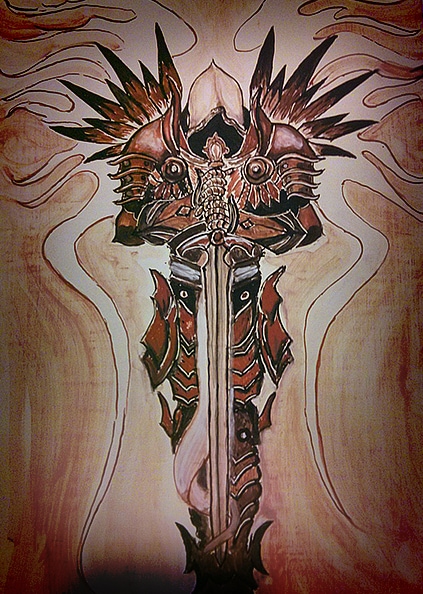
The completed painting before being fired.
Q. What made your mother do this particular socarrat?
I suggested she do something different than the usual socarrat drawings. I chose this image of Tyrael because it seemed ideal for a socarrat. The original image is fully colored, but the red and black socarrat style gave it a different aspect similar to the Diablo III opening cinematic.
Q. Do you have any other Diablo socarrats planned?
Not at this time, but who knows? Maybe a Malthael socarrat to put next to Tyrael. Or perhaps the whole Angiris Council discussing what to do with the black soulstone! I just have to make sure that the image can still be awesome when painted with only two colors.
Q. Are socarrats easy to make at home?
If you can find the materials, then yes, absolutely. But I think they could be hard to find outside of Valencia. And of course you need a ceramic oven nearby to fire the tile.
Q. What tips would you give to other aspiring artists interested in making their own socarrat?
Familiarize yourself with the classic socarrat style and get to know its particularities. You can find more examples with a simple online search. Start with the smallest and easiest pictures and be very careful while painting, since the colors are like dust before firing and they can spread over the tile easily and ruin the drawing.
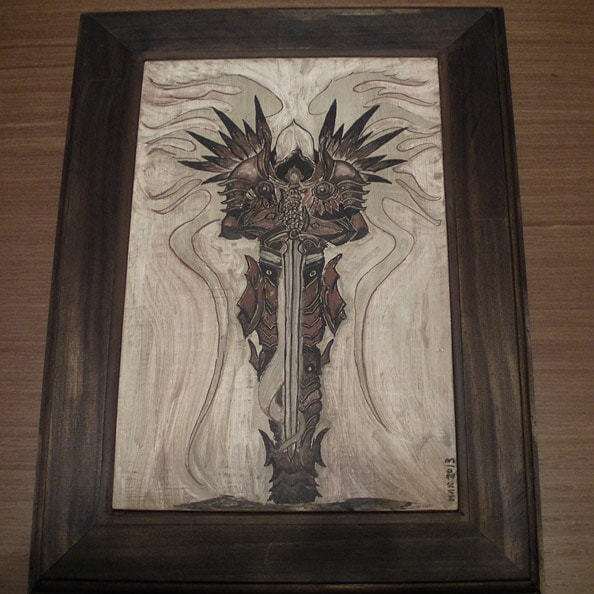
The finished and framed socarrat.
What do you think about this ancient art technique and the depiction of Tyrael? Would you try making your own? Let us know in the comments below.
If you’re working on any Blizzard fan creations, be sure to tell us about them in our Community Creations forum!
Blizzard Quote [source]
Two weeks ago, we revealed the first piece of concept art created by 3D character Aaron Gaines for our upcoming one-handed, Mephisto-themed sword. For those who may have missed that particular reveal, here's a screenshot:
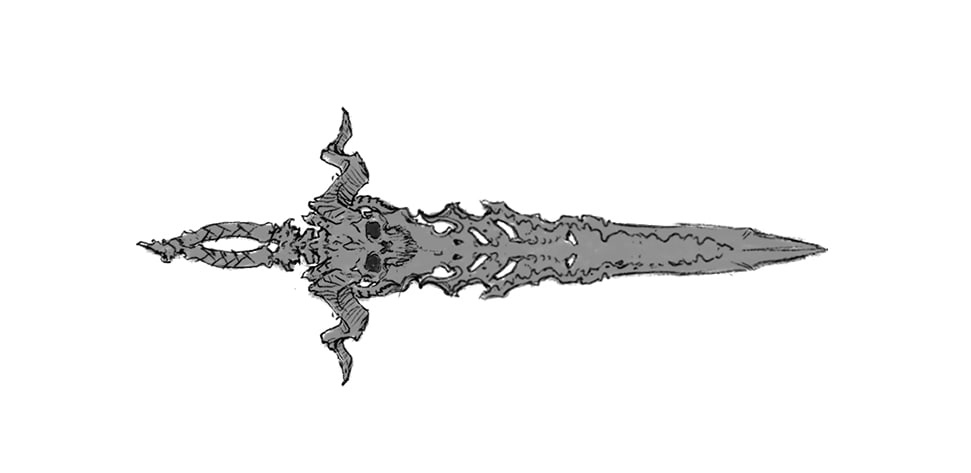
As noted, this was just the inital sketch, the first step in implementing the visual design of this particular Legendary weapon into the game. For many items in Diablo III, concepting goes through several stages, and today we're excited to share a new piece of concept art with all of you.
Many of you had feedback for Aaron, and he was excited to incorporate your suggestions and criticisms into this updated design. Some of the most notable changes based on player feedback include:
- Reshaping the horns to more closely resemble those borne by Mephisto
- Slimming down the blade's width
- Introducing more skeletal textures and imagery to evoke a spine-like feel
- Adding chains
Here are the results!

Thanks to everyone who provided feedback and suggestions. We'll have more visual progress updates and images to share in the new year.
Until then, happy holidays!
Previous Design a Legendary Articles:
- Introducing: Design a Legendary
- Design a Legendary, Part 1: Choose Your Weapon
- Design a Legendary, Part 1: Choose Your Weapon Results
- Design a Legendary, Part 2: Choose Your Theme
- Design a Legendary, Part 2: Choose Your Theme Results
- Design a Legendary, Part 3: "Choose Your Power" Livestream Coming Soon
- Design a Legendary, Part 3: "Choose Your Power" Livestream Now Available
- Design a Legendary, Part 4: Visual Design Progress